Car Lockouts
Locked your keys in the car in Pensacola? Learn how a mobile locksmith gets in without damage, what ownership checks apply, and what to do while you wait.
View service
Pensacola and Escambia County
Pensacola Locksmith is a mobile locksmith for cars, homes and businesses in Pensacola and Escambia County. Call to describe the problem, confirm what is involved and plan the visit.
Services
Locked your keys in the car in Pensacola? Learn how a mobile locksmith gets in without damage, what ownership checks apply, and what to do while you wait.
View serviceLost or broken car key in Pensacola? See how a replacement key is cut and programmed on site, what details you need, and how it differs from a dealership trip.
View serviceWhy a cut key alone will not start a modern car, and how transponder chips, remotes and push-to-start keys are programmed by a mobile locksmith in Pensacola.
View serviceLocked out of your Pensacola home? Learn how proof of residence works, how doors are opened without damage, and the follow-up checks that keep it secure.
View serviceRekeying in Pensacola explained: what it is, how it differs from replacing locks, and how it helps after a move, a breakup, lost keys or a tenant change.
View serviceReplacing locks in Pensacola: how to choose hardware, what the grades mean, and the door preparation checks a technician makes before installing new locks.
View serviceDeadbolt installation in Pensacola and Escambia County: single and double cylinder types, reinforced strike plates, and how the door and frame are checked.
View serviceCommercial locksmith service in Pensacola for storefronts, offices and multi-tenant buildings: hardware, master keying, key control and authority checks.
View serviceSafe opening and service in Pensacola: lost combinations, failed electronic locks, what proof of ownership is needed, and how to avoid a repeat.
View service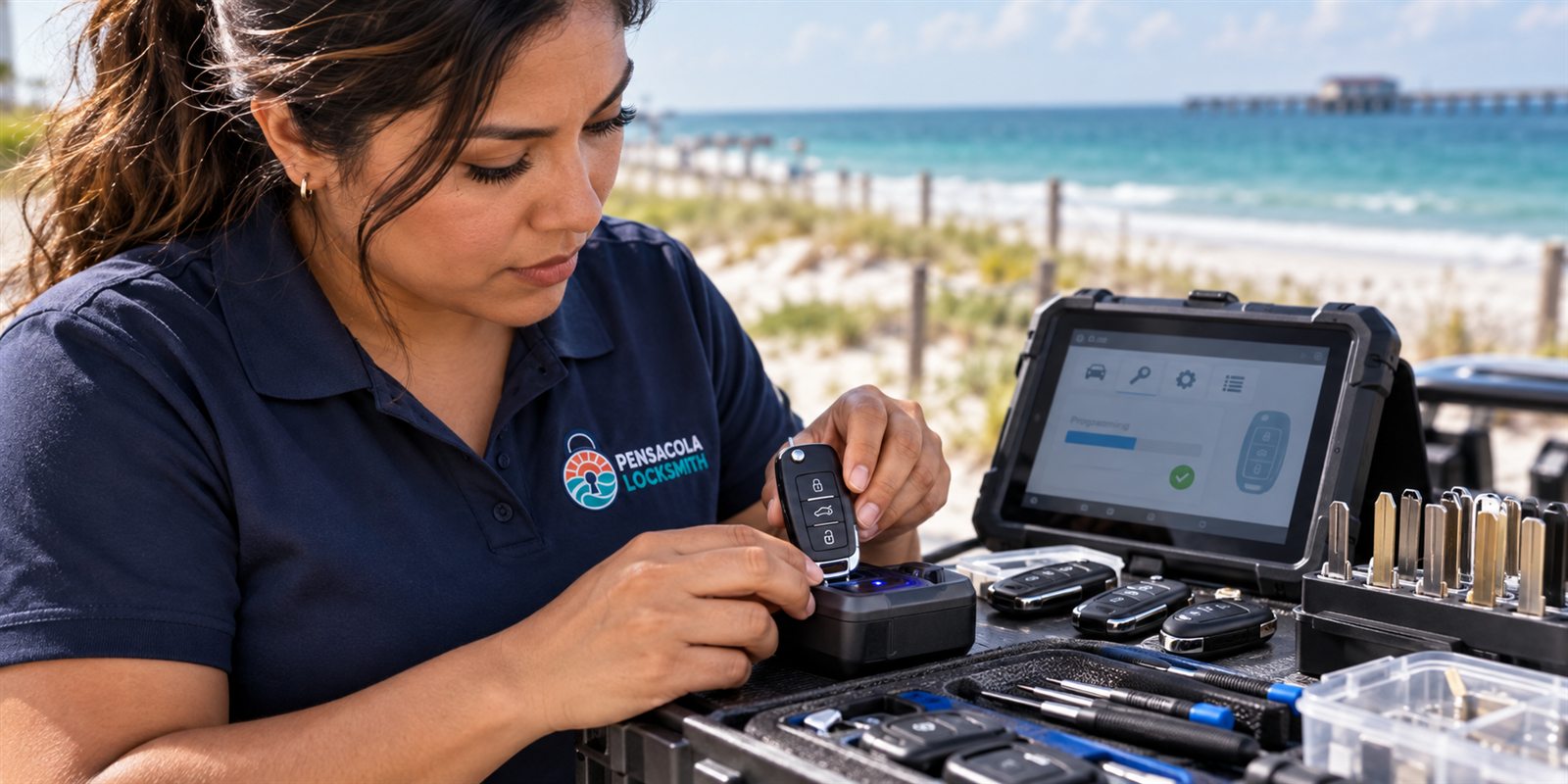
Automotive
A technician comes to the vehicle with the tools to open it, cut keys and program transponder chips, remotes and push-to-start keys. Ownership is confirmed first, and the details of the vehicle decide what is possible on site.
Residential
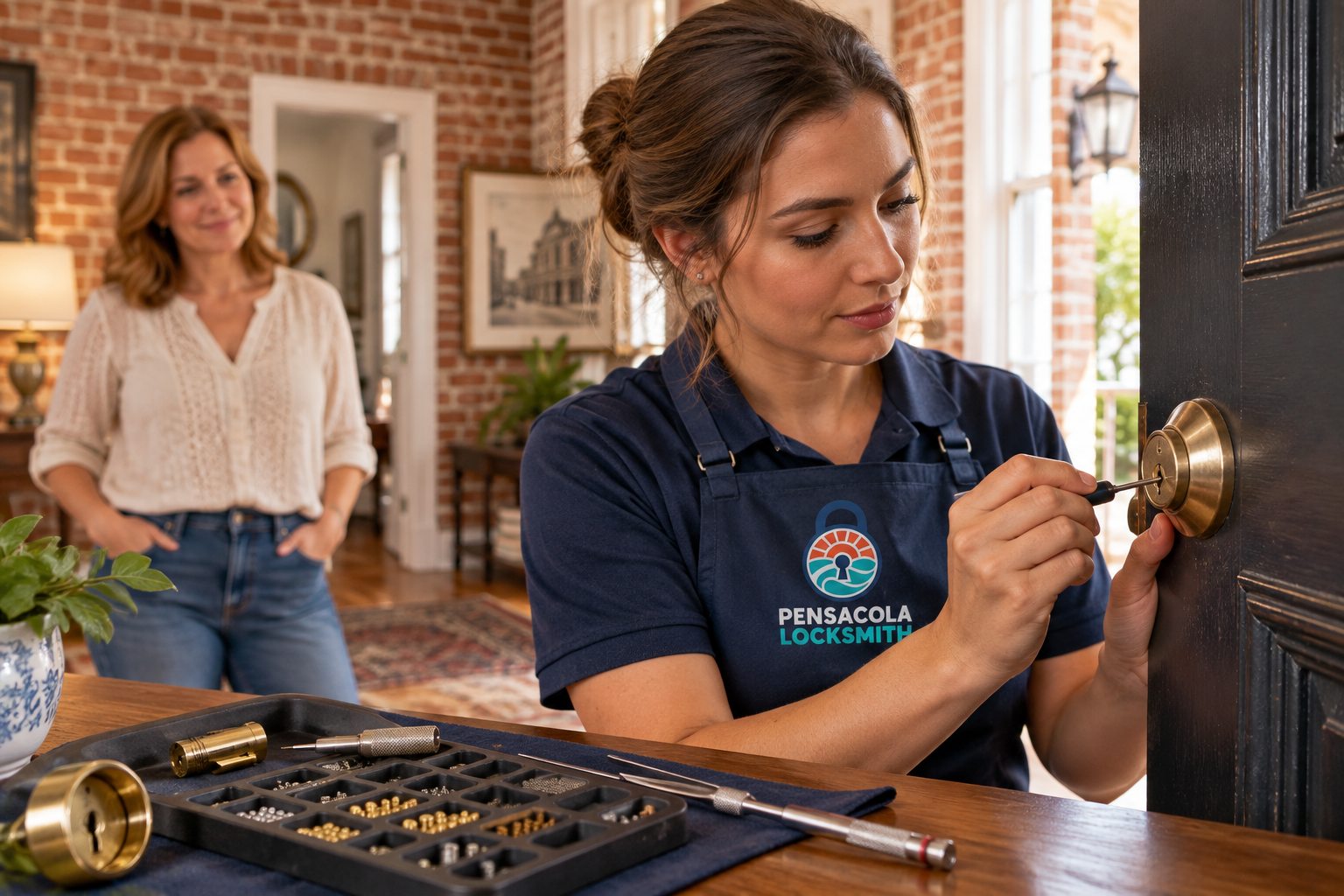
From a front door locked behind you to a rekey after a move, home lock work in Pensacola often means dealing with humidity, salt air and older hardware. We explain the options in plain terms and fit the fix to the door in front of us.
Areas
Content note: this page was written by Claude (AI) for Pensacola Locksmith.
Pensacola Locksmith is a mobile service that comes to you for car keys, house locks, business doors and safes. This page explains what we do, how a call and a visit work, what the Gulf Coast climate does to hardware, and how to pick a locksmith safely. Read it first, then call us to confirm availability.
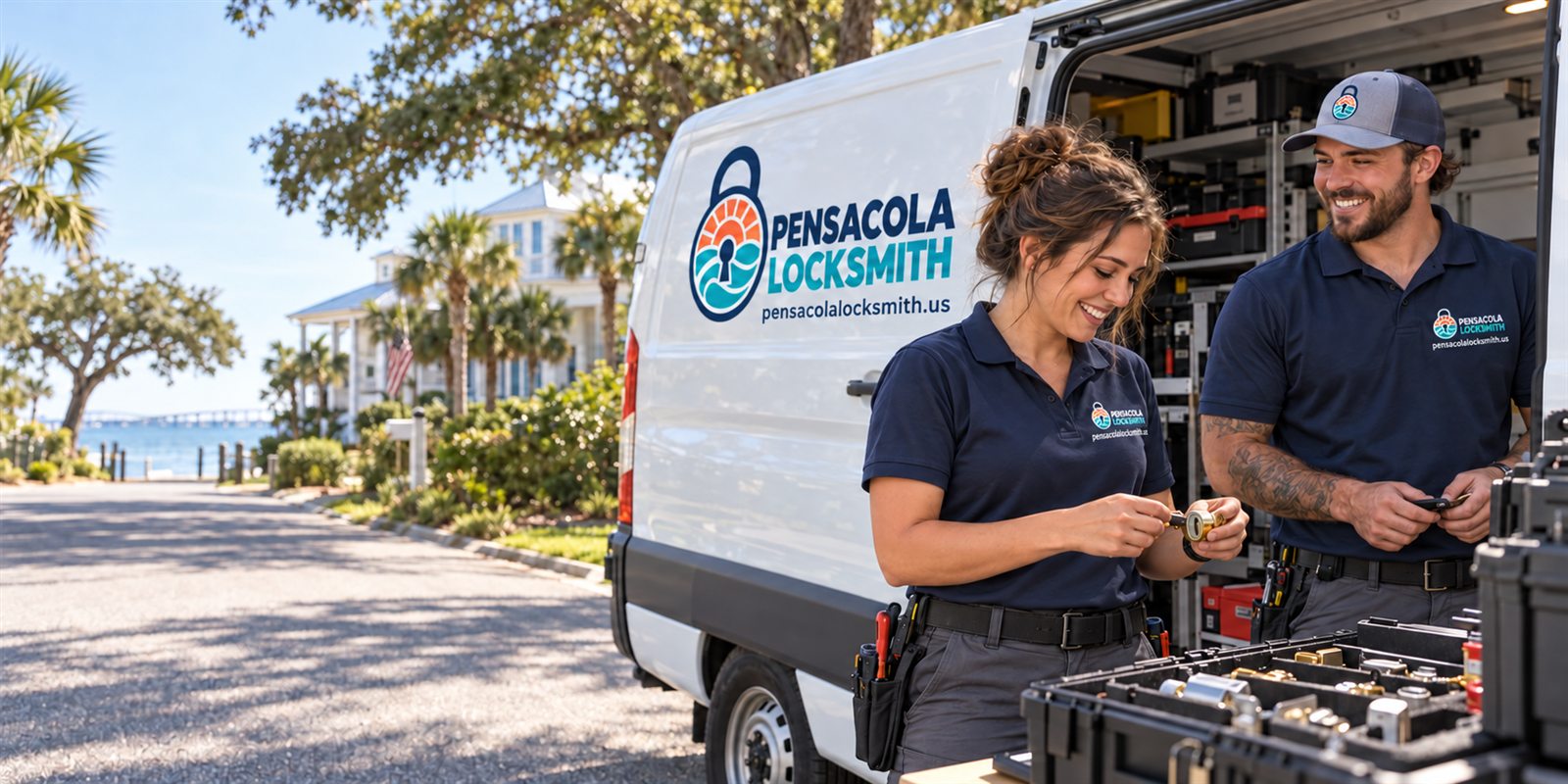
A mobile locksmith brings the workshop to your location. Instead of towing a car to a shop or waiting for a door to be fixed on a schedule that suits somebody else, the technician arrives with key cutting tools, programming equipment, lock cylinders, pick sets and the small parts that most lock problems call for. That means the work happens in your driveway, at your front door, or in the back of your shop, and you can watch what is being done and ask questions as it goes.
The job is wider than most people expect. Yes, a locksmith opens a locked car or a locked house. But the daily work also includes cutting duplicate keys, rekeying a lock so old keys stop working, repairing a deadbolt that sticks, replacing a broken cylinder, programming transponder keys and fobs, adjusting a door that no longer latches, and opening or servicing a safe. Some visits are emergencies and many are simply maintenance that has been put off for a year or two.
In and around Pensacola, a good share of calls come from the same few situations: a lockout in a parking lot after a beach day, a rental property that needs its locks changed between guests, a business that wants keys controlled after an employee leaves, and a family that just bought a house and wants to know who still holds a key. Each of these is a different problem, and this page walks through how we approach them.
Vehicle work is the part of locksmithing that has changed the most. Many modern keys carry a small chip that talks to the car, and a plain metal copy will turn the lock but will not start the engine. Other vehicles use a push button start with a proximity fob, and some use a laser cut key with a cut along the side of the blade rather than on the edge. We describe these only by general category, because what your particular vehicle needs is confirmed when you call and we know what you are driving.
The common vehicle jobs are lockouts, duplicate keys, replacement keys when one is lost, new keys when every key is gone, broken keys stuck in a door or ignition, and worn ignition cylinders that no longer turn smoothly. A technician can often cut and program a key at the vehicle, which saves the cost and hassle of a tow. When a job turns out to be more involved than it sounded on the phone, we tell you before work begins rather than after.
Before we open, cut or program anything for a vehicle, we check that you own it or have authority to act for the owner. That usually means matching the person in front of us to the registration or title and to a photo identification. It can feel like a small delay when you are standing in a hot parking lot, but it is the same check that protects you if a stranger ever tries to get into your car.
At a house, the most common request is a lockout, followed closely by rekeying. Rekeying changes the internal pins of your existing locks so a new key works and the old keys do not. It is the usual answer after moving into a home, after a roommate leaves, after a lost key, or after a contractor or tenant has had a copy. It costs less effort than replacing hardware, and the locks you already like on the door can stay exactly where they are.
Replacement is the better call when a lock is worn, damaged, loose in the door, or simply too weak for what it protects. We also install deadbolts, keypad and smart locks, and we adjust strike plates, latches and doors that have shifted so that the bolt actually seats in the frame. A lock only works as well as the door and frame around it, so a technician often checks alignment and screw length along with the lock body itself.
Rentals are a special case on the Gulf Coast. Vacation properties and long term tenants both turn over keys faster than owner occupied homes, and codes that were shared with one guest should not stay active for the next. Property managers and owners ask us to rekey between tenants, set up master key arrangements, and replace hardware that has taken a beating. As with every home job, we confirm that the caller owns the property or has authority from the owner before we change anything.
Commercial locks have different demands from residential ones. A shop door opens and closes hundreds of times a day, an office may need different keys for different staff, and a back door often has to meet safety rules about getting out quickly while still keeping unwanted visitors in check. We work on storefront locks, panic and push bar hardware, door closers, cylinders, file cabinets, desks and the keyed or coded locks that guard supply rooms and offices.
A frequent business request is key control. After a manager leaves or an employee is let go, an owner wants to be sure that old keys no longer open the building. Rekeying the cylinders and issuing a clear set of new keys is usually quicker and less disruptive than replacing every lock. For larger sites we can talk through a master key layout, where each person holds a key that opens only what they need, with the owner holding the one that opens everything.
Because a business lock protects stock, records and sometimes other people's property, we ask for proof of authority before we work on it. That may be the owner, a manager, or a property management contact who can confirm the request. When a job involves several doors, an after hours visit or work that could disrupt customers, we agree on a plan by phone first, so you know what to expect before a technician arrives.
Safes are a smaller part of the work, but they cause some of the most stress. A home safe that will not open might have a dead battery in its keypad, a bent bolt, a forgotten combination, or a lock that has simply worn out. A technician starts with the least invasive approach, checking power, trying known codes and testing the mechanism, and only moves to more involved methods when the simple ones fail.
Opening a safe without damage is a skilled job, and it is not always possible. Some safes are built specifically to resist manipulation, and opening them can mean drilling at a precise point and then repairing or replacing the lock afterward. We explain what is likely before we begin, including whether the safe may be left with a hole or need new parts. If the work is complicated, a technician visits first and the service call charge is explained before dispatch.
We also help with changing combinations, setting new user codes, replacing keypads and batteries, and advising on how to store the contents you cannot afford to lose. Because a safe often holds valuable or sensitive items, we confirm that the person asking owns it or has the owner's authority. If you are dealing with an estate, a purchased home, or a safe left by a previous owner, tell us that on the phone so we know what to ask for.
The process is meant to be simple and predictable. You call us and describe the situation: what is locked, where you are, what type of vehicle or lock it is, and whether anyone is at risk or stranded. We ask a few questions so we understand the job, and we explain what is likely involved. Please call to confirm availability, since we do not promise a time before we know where you are and what you need.
For most straightforward jobs, such as a standard lockout or a common key, you receive a quote by phone before anyone is sent. For jobs that are more complicated, such as a damaged lock, an unusual safe, or a vehicle with an uncommon key system, a technician visits to assess the situation first. In that case the service call charge is explained before dispatch, so you know what the visit itself involves before you agree to it.
On arrival the technician confirms identity and ownership or authority, looks at the lock or vehicle, and tells you what needs to happen. If the plan or the cost differs from the phone discussion, that conversation happens before work starts, and you can decline. After the work, the technician tests every key and lock with you, so you leave knowing that the door, the ignition or the safe operates the way it should.
Pensacola sits on the Gulf Coast, and the climate is hard on hardware. Warm, damp air and salt carried inland from the bay and the beaches speed up corrosion on exposed metal. Door hardware that looks fine on the outside can be gummed up on the inside, with lock pins that stick, cylinders that turn stiffly, and latches that drag. Keys wear faster in a stiff lock, and the first sign of trouble is often a key that needs a wiggle or a push to turn.
Simple habits help. Wipe the faceplate when you wash the house, keep keys from sitting wet in a pocket or a beach bag, and do not soak a lock in heavy oil, which collects dust and grit. A dry graphite or a lock specific lubricant, used sparingly, is a better choice. If a lock has started to feel rough, having it cleaned or rekeyed before it fails is usually easier than being locked out when it finally gives up.
Storm season adds its own problems. Wind and water push on doors, and frames can swell or shift, so a door that closed neatly in spring may not latch in the fall. After a storm, check that deadbolts still throw fully into the frame, that garage and side doors close tightly, and that electronic locks still have working batteries. If power or access has been disrupted, a locksmith can help restore security to a door that cannot be properly shut.
The housing around Pensacola is a mix, and each type of building brings different lock issues. Older and historic homes often have original doors, mortise locks and skeleton style keys that are hard to replace from a store shelf. These locks can usually be repaired, rekeyed or sometimes copied, but they deserve careful handling. A technician works with the existing hardware wherever possible, because the character of an older door is worth preserving.
Newer subdivisions have a different pattern. Builders often install the same basic hardware throughout a neighborhood, with keys that have passed through several hands before the house is even sold. Rekeying right after you move in is a sensible step, since you cannot be sure who held a copy. Many of these homes also have garage entry doors, patio sliders and smart locks that need to be adjusted, aligned or reprogrammed as the house settles.
Beach rentals and condos present a third picture. They see frequent turnover, salt exposure, sand in the mechanisms and lockboxes that guests sometimes forget to return. Owners and managers often want keypad locks that can be recoded between stays, keyed alike sets that make a property easier to manage, and regular maintenance on exposed hardware. Whatever the property type, we ask for proof that the caller owns it or manages it before we work.
Most key problems fall into a few categories, and knowing which one you are in helps us give you a useful answer on the phone. A lockout means the key exists but is inside the car or somewhere out of reach. A lost key means you still have another one. An all keys lost situation means no working key is available at all. A damaged or worn key means the key still works, but only sometimes. Each of these calls for a different approach, and each affects what the job involves.
With one working key, copying and programming a new one is usually the simplest path, and often can be done at your location. With no working key, the technician creates a new key from the vehicle itself, which can include reading the lock, cutting a blade, and programming a chip or a fob to the car's computer. This takes more steps, and the vehicle type matters a great deal, so the quote reflects what your car actually needs.
Fobs deserve a note of their own. A fob that has stopped working might only need a new battery, which is worth trying first. If the fob is cracked, water damaged or no longer recognized by the car, it may need to be replaced and programmed. Either way, we confirm ownership of the vehicle before we cut or program a key, and we will test every key and remote with you before we leave.
A little preparation makes the visit shorter and smoother. Before you call, note exactly where you are, what you need opened or changed, and what kind of lock or vehicle is involved. If you can, take a quick photo of the lock, door or key you have. Make sure you will be there in person or that someone with authority can be present, since the technician needs to confirm who you are and that you have a right to the property.
Gather your proof of ownership. For a vehicle, that is usually a registration or title and a photo identification. For a home, it might be a lease, a utility bill, a closing document or an identification that matches the address. For a business, it could be a business paper, a manager's authorization or a contact from the property owner. If you have no paperwork at hand, tell us when you call, and we will explain what other options exist.
Clear the area around the door or vehicle so the technician has room to work. Put pets in another room, move anything blocking a threshold, and keep any working keys you have within reach. If a lock is part of an alarm or smart home system, have your codes or app ready. If the job turns out to be more than a simple fix, you will have the information needed to make decisions quickly instead of hunting for documents while the clock runs.
A locked door is a vulnerable moment, and it is where careless or dishonest operators do their worst. Start by asking who you are speaking with and where the technician is coming from. Be cautious about vague phone greetings that never state a company name, quotes that sound surprisingly low and then change at the door, and anyone unwilling to explain what they will do and how the charge works. A trustworthy locksmith is happy to answer these questions plainly.
A real locksmith asks you for proof of ownership, not the other way around. If someone is willing to open a house or a car without checking who you are, they would do the same for a stranger. Ask how the quote is built, whether a service call charge applies, and what happens if the job is more complicated than described. You should hear the answers before the technician starts, and you should always be able to say no.
Watch the work itself. Drilling a lock that could have been picked, replacing a cylinder when a simple adjustment would do, or insisting on cash only are all reasons to pause. You are entitled to see the old parts and to have each new key tested before payment. When in doubt, stop and call back. A short delay costs far less than a rushed decision made at a dark parking space.
We serve Pensacola and the communities around it. That includes Pensacola proper, Pensacola Beach, Gulf Breeze across the bay, Perdido Key to the west, Cantonment and Milton to the north, Warrington near the naval air station area, and Ensley, Brent, Pace and Navarre as you travel outward. The area is spread across bays, bridges and rivers, which is one reason a mobile service makes sense: the locksmith moves, and you stay put.
Distance and traffic influence how a visit is planned, particularly during beach season, on event weekends or when a bridge is slow. For that reason we do not promise a specific arrival time. We ask that you call to confirm availability, tell us where you are, and we will give you honest information about the trip. If you are somewhere that is hard to find, such as a rental with a private drive or a condo with gate access, share the directions and access details when you call.
The mix of customers is as varied as the geography. Residents near the base and the university often need quick help with keys and vehicles, families in older neighborhoods ask for rekeying and repairs, and owners of beach rentals and small businesses want maintenance and key control. If your address is on the edge of this list or a little outside it, call and ask. We would rather tell you straight whether we can reach you than leave you guessing.
This website is organized so you can find help whether you are in a hurry or just planning ahead. The service pages describe the main kinds of work, such as car keys, home locks, business locks and safes, including what the technician does and what to expect. The guides go deeper into specific questions, such as what to do when a key breaks, how rekeying differs from replacing, and how to prepare an older door for new hardware.
If you are locked out right now, skip the reading and call us. If you are comparing options or have time to prepare, the guides are the better place to start. They are written in plain language, without sales pressure, and they explain the choices and tradeoffs honestly. You might find that your problem has a simpler fix than you expected, or that a small repair now prevents a more disruptive one later.
Whichever page you use, the next step is the same. Call us, describe the situation, and we will explain what is likely involved. Straightforward jobs are quoted by phone. Complicated ones get a technician visit, with the service call charge explained before dispatch. Ownership or authority is checked on site before work begins. That is how we handle every call, whether it is a spare key for a neighbor or a stuck safe at a small shop.
Yes. We are a mobile service, so the technician travels to your car, home, business or safe across Pensacola and nearby communities. Because distance, traffic and demand vary, call us to confirm availability and tell us exactly where you are. We do not promise an arrival time before we know the location and the job.
Call us and describe the situation, including the type of lock, door or vehicle. For straightforward jobs we give you a quote by phone before anyone is sent. If the job is complicated, a technician visits to assess it, and the service call charge is explained to you before dispatch so nothing about the visit is a surprise.
For vehicles, homes and businesses, we check ownership or authority before opening, rekeying or programming anything. This protects you, because the same check keeps a stranger from getting into your property. Usually a photo identification and a registration, lease, bill or similar paper is enough. If you lack paperwork, tell us when you call.
Rekeying changes the inside of a lock so old keys stop working, and it suits most situations such as a move or a lost key. Replacement makes sense when the lock is damaged, worn, loose or too weak for what it protects. A technician can look at the lock and the door and explain which choice fits your case.
Yes. Moist, salty Gulf Coast air speeds up corrosion and can make locks stiff, sticky or hard to turn. Keeping the faceplate clean, using a light lock lubricant sparingly and servicing a lock that feels rough can help. Storm season can also shift doors and frames, so check that your deadbolts still seat fully.