
Content note: this page was written by Claude (AI) for Pensacola Locksmith.
Where homes and businesses sit side by side
Ensley is the kind of place where a quiet residential street can be a block or two from a busy commercial strip. Homes, small shops, offices, restaurants and service businesses all share the area. That mix means a locksmith in Ensley does residential work in the morning and commercial work in the afternoon, and the skills are not the same.
Residential locks are about family, convenience and a sense of safety. Commercial locks are about controlling who can get in during business hours and after, meeting safety rules, and standing up to constant use. A front door at a shop may be opened hundreds of times a day, and the hardware needs to handle it without failing.
Both kinds of work begin with the same step. We confirm that the person asking has the right to approve the work. For a home, that is the owner or resident. For a business, that is the owner, manager or an authorized employee. We may ask for a document, such as a lease or a business paper, and we explain what is acceptable.
We do not promise arrival times, since traffic along busy roads and other calls change the day. When you call, tell us where you are, what kind of door or vehicle is involved and what the problem is. We give a quote by phone, and we ask you to call to confirm availability.
Commercial doors along a busy highway
Shops and offices along a major road see steady foot traffic, and their doors work hard. Aluminum storefront doors with glass panels are common. These doors have narrow frames, which means the lock hardware is specialized. Standard residential parts do not fit, and a mismatch causes poor action and weak security.
A typical storefront door uses a rim cylinder or a mortise-style lock, a pivot hinge at the top and bottom and a closer that controls how the door swings shut. Over time, any of these can wear. A door that no longer closes by itself, or that drags on the floor, usually needs adjustment at the pivot or closer rather than a new lock.
Glass doors present extra concerns. A lock mounted on a thin frame near large glass is easy to defeat with force if the hardware is weak. Adding a second lock point, such as a top or bottom bolt, or a heavier strike, can help. Security film on the glass is another option, though that is outside our work. We focus on the locks and hardware.
When you call about a storefront door, describe what you see. Is the lock built into the handle, or is there a separate cylinder? Does the door have a narrow aluminum frame or a wider wood one? Is there a closer at the top? Photos help if you can send them. That information lets us bring the right parts the first time.
Panic bars, exit devices and safety rules
Many commercial buildings need exit hardware that lets people leave quickly in an emergency. A panic bar, also called an exit device, lets someone push a bar across the door to unlatch it, even if the door is locked from outside. These are common on back doors, side doors and in larger rooms where many people gather.
Exit devices wear out. Springs weaken, latches stick and the bar can loosen from the door. A device that does not release smoothly is a safety problem, because someone in a hurry may not be able to leave. If you notice that your panic bar is stiff, loose or noisy, have it checked. We can adjust, repair or replace it.
Fire and building rules apply to exit doors. A locked door that blocks an exit route is not acceptable, and chains or padlocks on exits are a known hazard. We respect those rules. If you want to improve security on an exit door, we look for ways to do it that keep the exit working, such as alarms or delayed devices where allowed.
If you are not sure what applies to your building, ask the local fire authority or building official. A locksmith can advise on hardware, but code decisions belong to the authority. We will not install anything that we know would violate the rules, and we will tell you if a request seems unwise.
Key control for shops, offices and landlords
Small businesses often start with a few keys and end up with a handful of copies that nobody tracks. An employee leaves, a key goes missing, a cleaner stops coming, and the owner does not know who can get in. This is common, and it is fixable. The first step is to count keys and decide who truly needs one.
Rekeying resets control. The existing locks stay, and the internal pattern changes so old keys stop working. This is a sensible response whenever a key is lost or an employee leaves on poor terms. For businesses with many staff, a restricted keyway makes copying harder because the blanks are controlled and cutting needs authorization.
A master key system helps larger operations. Each area has its own key, and a master key opens all of them. A manager can open any door, while a clerk opens only the front and the stockroom. Setting this up takes planning, and it is best done before the business grows. We can discuss how many levels you need.
Landlords with several tenants have a similar need. Between tenants, rekey the unit. Keep a record of keys issued and returned. If your building has a shared entry, think about who controls it. We ask for authority before changing any lock, and we may want to see a lease or ownership paper, particularly when a tenant asks to change a lock on a leased space.
Suburban homes and everyday lock problems
Most homes in Ensley are the kind of suburban houses found across the region, with standard doors, builder-grade hardware and a garage. The common lock calls here are ordinary and very real: a lockout, a lost key, a deadbolt that sticks, a knob that falls apart or a door that no longer latches. These are all fixable, often in a single visit.
Builder-grade hardware is meant to be adequate on the day the house is sold. It is not always meant to last or to resist force. Over the years, screws loosen, springs weaken and the finish wears. A new deadbolt with a hardened bolt, a reinforced strike plate and long screws into the framing makes a big difference at modest effort.
Rekeying is a useful upgrade. If you have lived in the house for years and have given keys to relatives, neighbors and workers, a rekey resets who can enter. If you bought recently, it clears out the previous owners and agents. Matching all doors to one key simplifies life. We confirm ownership or residency before starting.
Do not forget the garage door and the door between garage and house. An opener remote left in a car, or a connecting door with a flimsy knob, can negate good locks elsewhere. Treat remotes like keys, reset opener codes when you move, and give the interior door a deadbolt. We can help with the locks, and the opener maker covers the rest.
Lockouts at home, at the shop and in the car
A lockout can happen anywhere. A parent steps out to take a package and the door closes. A shop owner leaves the key inside while taking out trash. A driver closes the door with the key on the seat. Each is stressful, and each has a practical solution.
We start by confirming that you are who you say you are and that you have the right to open the door. For a home, photo identification with an address is ideal. For a business, we may ask for a business license or lease, and we look for signs you work there. For a car, we want registration or title that matches your identification.
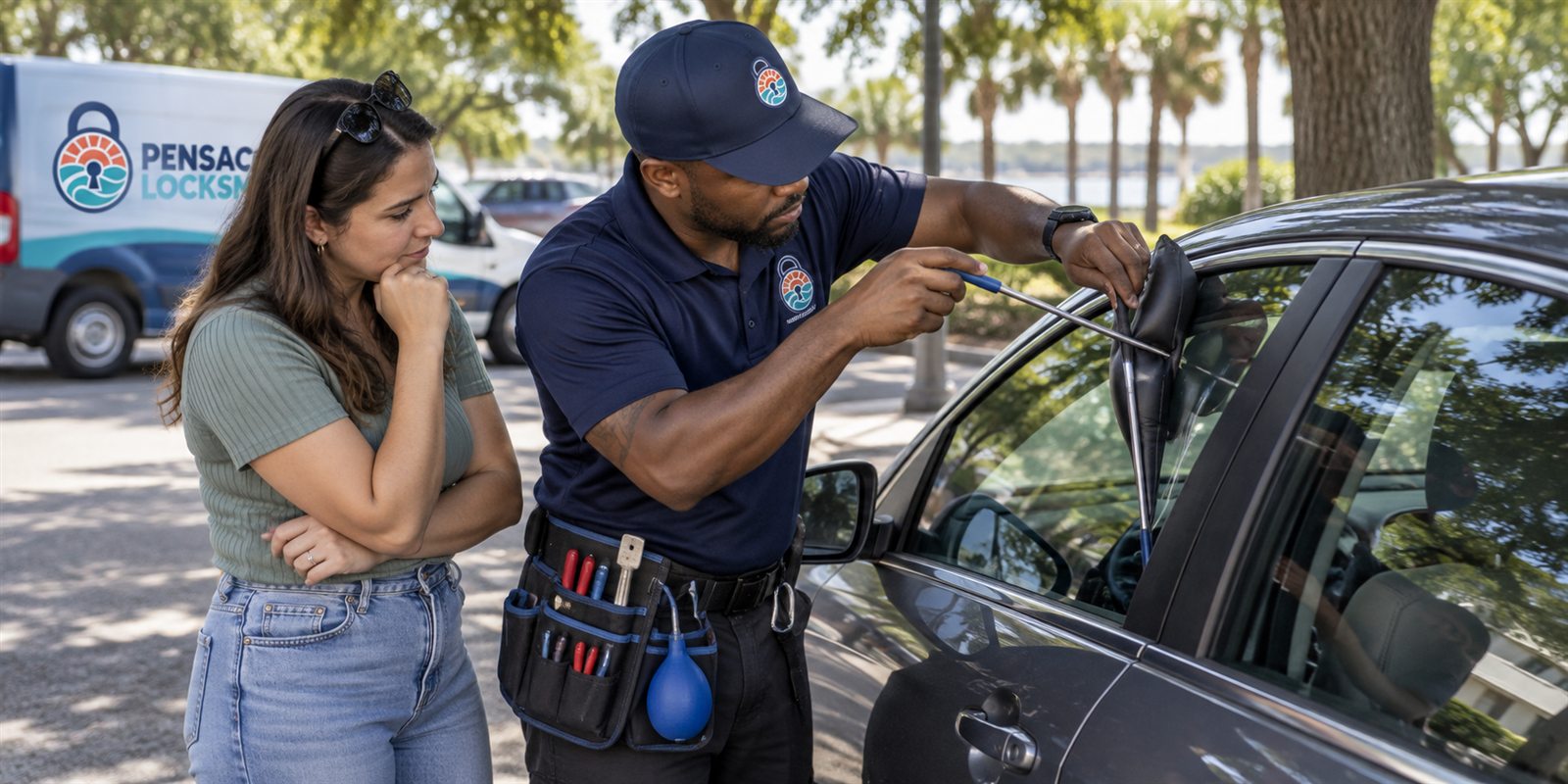
The tools we use are meant to avoid damage. For a house door, picking or bypass tools can often open the lock. For a storefront, the approach depends on the hardware, and we try the least destructive way first. For a car, we use tools that reach the lock or handle without scratching paint or bending the frame.
If something goes wrong, such as a broken key stuck in the lock or a damaged cylinder, we may need to remove and replace parts. In more complicated cases, a technician visits first and the service call charge is explained before dispatch. We would rather tell you the truth about the work than surprise you at the door.
Car keys for commuters and delivery drivers
Davis Highway and the roads around it carry a lot of traffic, and many people in Ensley drive for work. Delivery drivers, contractors, sales staff and commuters all depend on vehicles. A lost or broken key is not just an inconvenience for these drivers. It can stop an income for the day.
We come to the vehicle. After confirming ownership or authority, we read the vehicle number, cut a blade if the key has one and program the key to the car. This applies to chip keys, remote head keys and smart fobs. Mobile service means no tow, and the car stays where it is.
For businesses with a fleet, it helps to keep a spare for each vehicle in a secured box in the office. A log of who has which key avoids confusion. If a driver leaves, you may want to remove their key from the vehicle's memory or rekey the locks. Ask us what the vehicles allow, since systems differ.
If you drive a company vehicle, bring a letter or document from the owner that shows you can authorize key work. A lease or work order may also do. We check authority for every vehicle, and we explain what to have ready when you call. A short call before the visit prevents delays.
Door closers, hinges and the small things that cause big problems
Many lock complaints are really door problems. A door that does not close fully will not latch, no matter how good the lock. A door that sags drags the bolt against the strike. A closer that slams or is too weak makes people prop doors open. Fixing the door often fixes the lock.
Hinges are the first suspect. Loose screws let the door drop, and worn pins let it wobble. Tightening the screws, or replacing them with longer ones that reach the frame, can restore alignment. For heavy doors, three or four hinges share the load better than two. A technician checks the gaps around the door to see where it rubs.
Door closers control how a door swings shut. They have adjustment screws for closing speed and latching speed. A door that stops short of the latch needs a small tweak. A leaking closer, shown by oil on the arm or the floor, needs replacement. In busy places, a good closer is a key part of both security and comfort.
Weather affects all of this. Gulf humidity swells wood and warps thin metal, so a door that is fine in winter may stick in summer. Checking these items twice a year, once before the wet season and once after, keeps things working. We are glad to look at the whole door, not just the lock.
Opening and closing routines that protect a business
Many break-ins and lockouts at shops come down to routine, not equipment. The person who locks up at night is tired, the person who opens in the morning is rushed, and a door gets left unlatched or a key gets left on a counter. A simple written routine, kept by the door, turns good intentions into habit.
At closing, someone should walk the space, try each exterior door, confirm the back door is latched and check that any panic bar is fully engaged. Keys should go to a set place, not a pocket that leaves the building. If you use a keypad lock, change the code when staff change, and never share a single code among everyone for years.
At opening, check doors for signs of tampering before entering. Scratches around a lock, a bent strike or a door that is slightly ajar are clues worth noticing. If something looks wrong, do not enter alone. Call the proper authorities. A locksmith can later repair or replace damaged hardware, and we ask for proof of authority before work begins.
Keep a spare key in a secure spot off the premises, held by someone you trust. A lockout at the start of the workday can cost a morning of business. A spare, or a keypad lock with a backup key, turns that problem into a minor delay. We can help set up either arrangement and explain how each one behaves if something fails.
Weather and wear on exposed doors
Doors along open commercial strips take the weather head-on. Afternoon sun heats metal frames, thunderstorms push rain against the threshold, and humidity swells wood and sticks hinges. Over time, these conditions wear on both the door and the lock. A lock that worked well in winter may feel rough by late summer.
Cleaning and lubricating help. Use a dry lubricant in cylinders and latches, and wipe handles and frames with a damp cloth. Avoid heavy oil, which collects dust and grit. Check the threshold and the weatherstrip for gaps. A door that does not seal well lets in moisture and dirt that shorten the life of the lock.
Glass doors and aluminum frames expand and contract with heat. This can loosen screws and shift the alignment of the lock and strike. A quick look at the gap around the door shows whether the latch is lining up. If the gap is uneven, a technician can adjust the pivot or hinge and restore smooth action.
Before hurricane season, test every door. Make sure bolts extend fully, panic bars release smoothly and closers close the door completely. After a storm, check again, since wind can shift frames. A door that closes loosely is a weak point, and it is easier to fix before a problem than after one.
What happens when you call
Tell us where you are and what the job is. We ask about the type of door or vehicle, the lock and the problem, and explain the likely steps. Quotes are given by phone. We do not promise arrival times, and we ask you to call to confirm availability, especially during busy traffic hours and storm periods.
For standard work, one visit usually does it. If the problem is complicated, such as a damaged cylinder, a malfunctioning exit device or a car with a security fault, a technician visits first and the service call charge is explained before dispatch. You know the terms before anyone is on the way.
At the door, the technician checks identity and authority, looks at the lock or vehicle and explains the plan. You choose whether to go ahead. When the job is finished, we test the lock and keys with you, clean up and show you how to care for the hardware.
Afterward, keep a list of keys and who holds them. Store spares in separate places. If something feels wrong within the first few days, call us. A small adjustment is normal as new hardware settles. We would rather hear from you than leave you with a problem that grows.
Common questions
Do you serve Ensley and Davis Highway businesses?
Yes. Ensley homes and the shops and offices along its commercial corridors are part of our service area. We do not promise arrival times, so please call to describe the job and confirm availability.
Can you repair storefront doors and panic bars?
Yes. We work on aluminum storefront locks, closers, hinges and exit devices. Describe what you see when you call, and send photos if you can. For code questions about exits, we advise confirming with the local authority.
What do you need to confirm before working on a business door?
We check that you are the owner, manager or an authorized employee. A lease, a business document or a letter from the owner can help, and photo identification is expected. If the landlord controls the door, we ask for their approval.
Is rekeying useful for a small business?
Yes. Rekeying resets who can enter without replacing the locks. It makes sense after a lost key or an employee leaving. For larger operations, a master key system or restricted keyway offers more control. We can discuss options by phone.
How do I get a quote?
Quotes are given by phone. If the job is complicated, a technician visits first and the service call charge is explained before dispatch. Call us with details and we will go through the work with you.