
Content note: this page was written by Claude (AI) for Pensacola Locksmith.
Why travelers get locked out more often
People who are traveling are tired, carrying more than usual, and working from a routine they do not normally follow. They set a key fob on a luggage cart, drop a spare in a jacket pocket that gets checked, or step out of a rental car with the engine running while they pull a bag from the back seat. None of this is careless in a serious way. It is simply what happens when the usual habits are interrupted by a flight, a time zone, or a long drive.
In the area around the airport, those moments tend to cluster at predictable places: the curb, a hotel parking space, a gas station on the way in, or a parking lot where the car has sat for several days. A locksmith who works in this part of Pensacola sees the same few situations repeat. The key is inside, the key is gone, or the key works but the car will not respond.
The practical point for a traveler is that you do not have to solve it alone. A mobile locksmith comes to the vehicle, so you do not need to leave your luggage, arrange a tow, or find a ride to a shop. Call us, describe where you are and what happened, and we will tell you what kind of help fits the situation and whether availability allows a visit.
Rental cars and what is different about them
A rental car belongs to someone else, and that changes how a locksmith approaches it. Before opening a rental vehicle or making a key for it, the locksmith needs to be sure the person asking has the right to be in the car. That usually means the rental agreement in your name, a matching photo ID, and sometimes a call to the rental desk. This is a normal safeguard, not a roadblock, and it protects both you and the owner of the car.
It is also worth knowing that many rental companies have their own roadside process for lockouts and lost keys, and their agreement may require you to use it. Reading the agreement or calling the number printed on the key tag or the contract is a reasonable first step. If you are told to use your own help, a locksmith can often open the car without damage, which avoids a charge for a broken door or window.
If the key is lost rather than locked inside, the situation is more involved. Modern rental vehicles often use transponder keys or proximity fobs that must be programmed to the car. A technician can sometimes do this on site, but it depends on the vehicle and the tools it requires. When the job is complicated, a technician visits, and the service call charge is explained before dispatch.
Hotel guests and parking lot lockouts
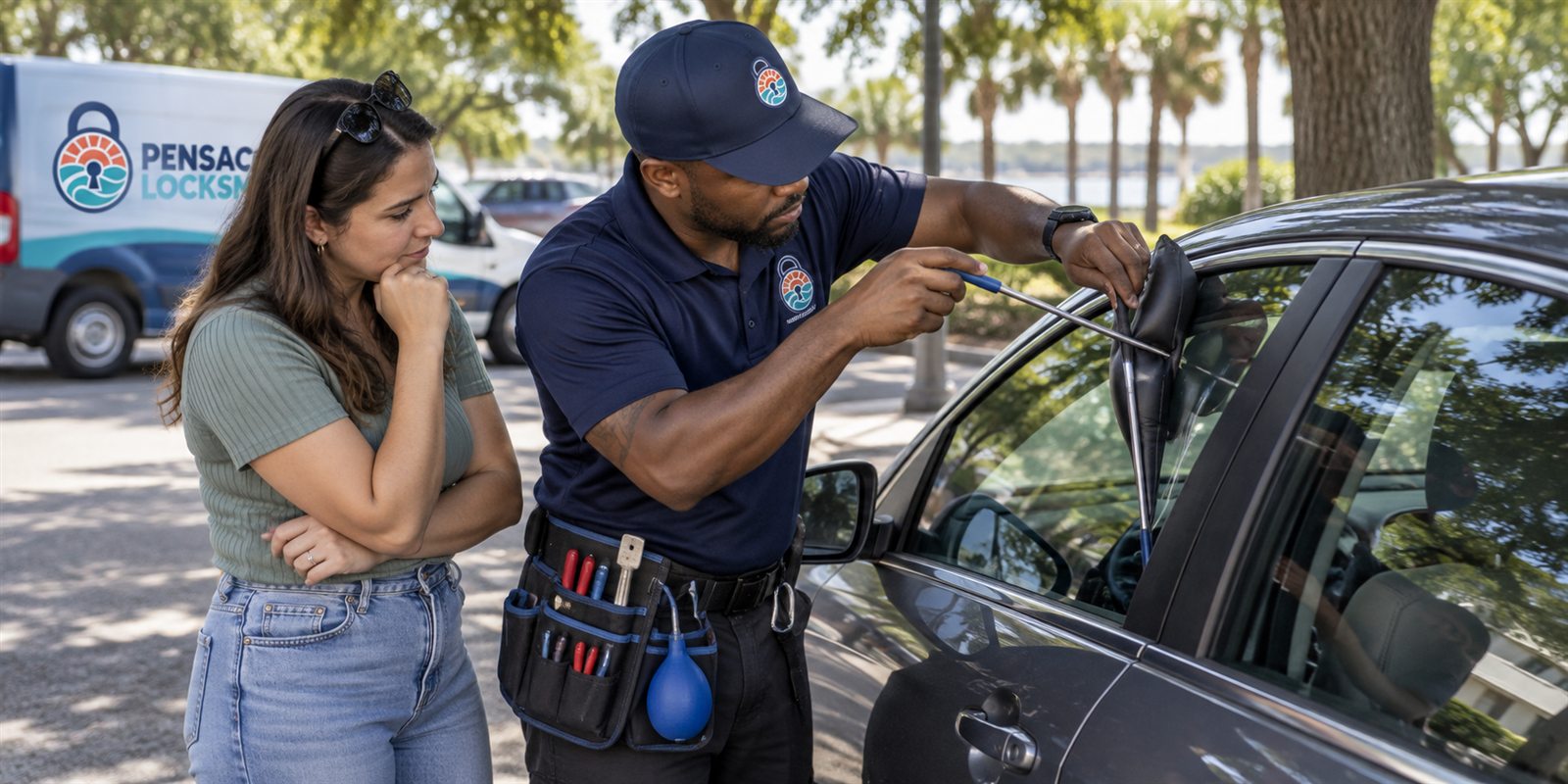
Hotels near the airport have large parking lots that are busy at all hours with people arriving late and leaving early. A lockout in one of those lots is stressful mostly because of the setting: you may be carrying a sleeping child, a work bag, or a plane ticket you need within the hour. The first thing a locksmith does on arrival is look at the car, confirm what kind of lock and key system it has, and choose the least invasive way in.
Most vehicle lockouts are handled without any damage to paint, weatherstripping or the door. The technician uses a protective wedge to create a small gap and a long tool to reach the unlock control, or works the lock directly when the design allows. Rushing makes scratches, so a calm approach is part of the job. If you can tell the technician whether the doors unlock with a button inside or only by key, it helps them choose the right method.
Hotel guests also run into room-level problems, but those are the property's responsibility. A hotel controls its own guest room locks, and a locksmith will not open a room that is not yours or the hotel's to authorize. If your car is the issue, we can help. If your room card stops working, the front desk is the right place to go, and they can reissue a card quickly.
Lost keys when you are far from home
Losing a car key away from home is a different problem than locking it inside. If the key is completely gone, the vehicle needs a new one cut or generated, and in most modern cars that new key also has to be introduced to the car's computer. Some vehicles accept this through a diagnostic port. Others require more steps, such as a security code or a way to confirm ownership with the manufacturer's system.
The honest answer is that how long this takes depends on the vehicle. A simple key for an older car can be done on site. A newer proximity key may take longer, and in some cases the vehicle needs to be at a shop or the dealer. A good locksmith tells you this up front rather than letting you wait in a parking lot for something that cannot be done there.
Ownership comes first. For a car you own, expect to show the registration or title and a photo ID that matches. For a rental, the agreement is the proof. This check applies to every vehicle, including your own, and it is the reason a locksmith can be trusted with a key to a car. If you cannot produce documents right away, say so on the phone, and we will explain what is possible.
Cars left in long-term parking
Cars that sit for days or weeks while their owners are away have their own set of problems. The battery may be weak or dead, and when a car battery is low, the door lock actuators can behave strangely. Key fobs may not unlock the doors at all, or the doors may lock and unlock on their own. People often assume the fob has failed when the real cause is the car's battery.
A mobile locksmith can tell the difference by testing the fob and the lock separately. If the fob battery is simply weak, replacing it is a small job. If the car battery is the issue, the locksmith may be able to get you inside using the mechanical key hidden in the fob, but starting the vehicle is a job for a jump or a battery replacement, not for lock service. Knowing which problem you have saves time.
It also helps to think ahead before a trip. Carry a spare key somewhere other than your luggage, and know where the physical emergency key in your fob is released. Many people have never opened the fob and are surprised to find a small metal blade inside. Finding that out in your driveway is much easier than finding it out at midnight after a flight.
- Locate the hidden mechanical key in your fob before you travel
- Keep a spare key with someone you trust, not in the same bag
- Replace weak fob batteries before a long trip
- Take a photo of your registration and keep it on your phone
Gulf Coast weather and keys
Pensacola sits on the Gulf Coast, and humidity and salt air affect metal hardware over time. Car door lock cylinders, trunk locks and fob contacts can corrode, especially on vehicles that spend time near the water. A key that once slid in easily may begin to drag, or a fob may work only some of the time. These are slow problems, and they often show up at the worst moment.
Visitors from drier places are sometimes surprised that a lock they never think about can stick after a humid week or a rainy stretch. A small amount of the right lubricant, such as graphite or a product made for locks, can help. Heavy household oil attracts grit and tends to make things worse in the long run, so it is better avoided inside a lock cylinder.
Hurricane season is another local reality. People evacuate with little notice and may leave cars in unfamiliar lots or return to find that locks and electronics are not behaving normally after a power surge or flooding. If a vehicle has been in water, the electrical system should be checked before anyone tries to program keys, because water damage can cause problems that are not about locks at all.
What to have ready when you call
A short phone call goes much better when you have a few details ready. Be able to say where the vehicle is, the make and general year range, whether it uses a metal key, a chip key, or a push-button start, and what exactly happened. Tell us whether anyone or anything is inside the vehicle, such as a child or a pet, because that changes how urgently we treat the call and what we advise you to do while you wait.
If anyone is in danger, such as a child or animal locked in a hot car, contact emergency services first. A locksmith is not a substitute for them in that situation. On the Gulf Coast, a closed car can become dangerously hot much faster than most people expect, and that risk is the one case where waiting for any service is the wrong choice.
Have your identification and proof of ownership or rental ready, and stay with the vehicle if you can. Quotes are given by phone, based on what you describe. If the job turns out to be more complicated than it sounded, a technician visits and the service call charge is explained before dispatch. Call us to confirm availability for your location.
Residents near the airport
Not everyone near the airport is traveling. Plenty of people live in the neighborhoods and apartments around it, and they have the same needs as anyone else: a home lockout, a lock that has stopped working, a rekey after a roommate moves out, or a deadbolt that no longer feels secure. Noise from aircraft is a fact of life there, and so is the steady turnover of renters and short-stay occupants.
For landlords and property managers, turnover is the main reason to think about rekeying. When a tenant leaves, the keys they hold still work unless the lock is changed or rekeyed. Rekeying changes the internal pins so the old keys no longer operate the lock, usually without replacing the hardware. It is a sensible habit between tenants, and it is not expensive in time because it can often be done at the door.
For a home lockout, the locksmith will ask you to confirm that you live there before opening the door. This might mean a document with your name and the address, or a photo ID that matches. It can feel like an extra step when you are standing outside in the heat, but it is the same protection that keeps someone else from walking into your home.
How mobile service works in practice
When you call, you describe the situation, and we ask a few questions. Is it a car, a home or a business? What kind of lock or key is involved? Where are you? From those answers we can usually give you a quote by phone for a straightforward job. We cannot promise an arrival time, so please call us to confirm availability for your location and ask what is realistic.
On site, the technician confirms who you are and that you have the right to access the vehicle or property. Then the work begins, and the technician explains what they are doing and what they find. If the problem turns out to be bigger than expected, such as a damaged lock or a key system that needs special equipment, they will say so before going further, and you decide whether to continue.
After the work, test the key or lock a few times while the technician is still there. Check that spare keys work too. If you are traveling, ask whether it makes sense to have a spare made while the technician is present, since that is much easier than losing another key later. Then you can get back to your trip, your flight, or your day.
Small habits that prevent a travel lockout
Most travel lockouts come from a handful of habits that are easy to change. Always pocket the key or fob before you open the trunk or hatch, because the doors can lock automatically on many vehicles when the key is left behind. Check your pockets before closing any door, and make it a rule that the key never goes into a bag you are about to set down or hand to someone else.
If you share a rental with other travelers, agree on who holds the fob. Two people each assuming the other has it is a classic way to lock a key inside. Some drivers also keep a spare key card or a basic metal key in a wallet, which works only if the car has a mechanical key to match. Ask the rental desk whether a spare is available when you pick up the car, since that costs nothing in time.
Finally, know your own situation before an emergency. Save the contact details of a locksmith in your phone, keep a photo of your registration, and learn whether your car has a physical key hidden in the fob. A few minutes of preparation at home turns a stressful lockout in a parking lot into a short, manageable errand.
Common questions
Can a locksmith open a rental car near the airport?
Often yes, but the locksmith needs to confirm you have the right to enter the car first. A rental agreement in your name and a matching photo ID are the usual proof. Some rental agreements require you to use the company's own roadside process, so check that before calling. Call us to confirm availability and what we can do for your situation.
What if I lost my only car key while traveling?
A new key can usually be made, but newer cars need the key programmed to the vehicle, which depends on the model and may take more time or special equipment. You will need proof of ownership or a rental agreement and photo ID. Describe the vehicle on the phone, and we will explain what can be done on site.
Do you help with hotel room doors?
No. A hotel controls its own guest room locks, and a locksmith should not open a room that is not yours to authorize. If your room card stops working, the front desk can reissue it. We can help with your vehicle, your home or your business if you need lock or key service.
Can you give a quote before sending someone?
Yes, for straightforward jobs a quote is given by phone based on what you describe. If the job is complicated, a technician visits and the service call charge is explained before dispatch, so you know the terms before work begins. Call us and describe the lock, the key and where you are.
Will opening my car damage it?
A careful technician uses protective wedges and proper tools, and most lockouts are solved without damaging paint, seals or the door. Rushing or forcing a door is what causes damage. If you can tell the technician whether the doors unlock from inside or only by key, it helps them choose the safest method.