
Content note: this page was written by Claude (AI) for Pensacola Locksmith.
What a Lexus key usually looks like today
Lexus vehicles use a few broad categories of key, and knowing which one you hold is the first step in any conversation about replacement. Older vehicles of the brand often use a metal blade key with a plastic head that contains a transponder chip. Newer vehicles tend to use a smart key, a fob you can leave in a pocket or purse while the vehicle senses it nearby. Some sit between those two, with a remote and a chip in the same head.
The category matters because each one is made and programmed differently. A chip key needs a blade that is cut to fit the ignition or door lock and a chip that the vehicle's immobilizer will accept. A smart key needs a transmitter that speaks the right radio language, plus a small blade for emergencies. Both need the vehicle to agree that the new key belongs to it.
When you call, describe what you have: whether you push a button to start the engine or turn a key, whether the fob has a printed logo, and whether there is a slot or a button on its side. Those details help a technician decide what to bring. If you are not sure, a photo of the key and the dashboard start area can settle the question quickly. Call us to talk it through and confirm availability.
Smart keys and how the vehicle knows you are close
A smart key works by exchanging short radio messages with the vehicle. When you touch a door handle or press the start button, the vehicle sends out a low power signal and the fob answers with a coded reply. If the reply is correct, the doors unlock or the engine is allowed to start. The code changes in a pattern that both sides know, so a simple copy of a radio signal is not enough to fool the system.
That design is the reason these fobs cannot be duplicated the way an old brass key can. A locksmith cannot just trace the shape. The new fob has to be enrolled into the vehicle's computer, which means connecting diagnostic equipment to the vehicle and following the steps the system requires. Some vehicles allow enrollment with the existing key present, and some require the computer to be placed in a learning mode first.
People are sometimes surprised that a fob bought online does not work even though it looks identical. Looks are not the point. The internal electronics, the frequency and the chip family all have to match what the vehicle expects. A technician can check this before any work begins, which avoids paying for a part that cannot be used. We can look at a fob you already own if you bring it to the conversation.
- Proximity fob with a push button start
- Chip key with a separate remote
- Blade key with a transponder in the head
- Fob that is also used for trunk or hatch release
The little blade hidden inside the fob
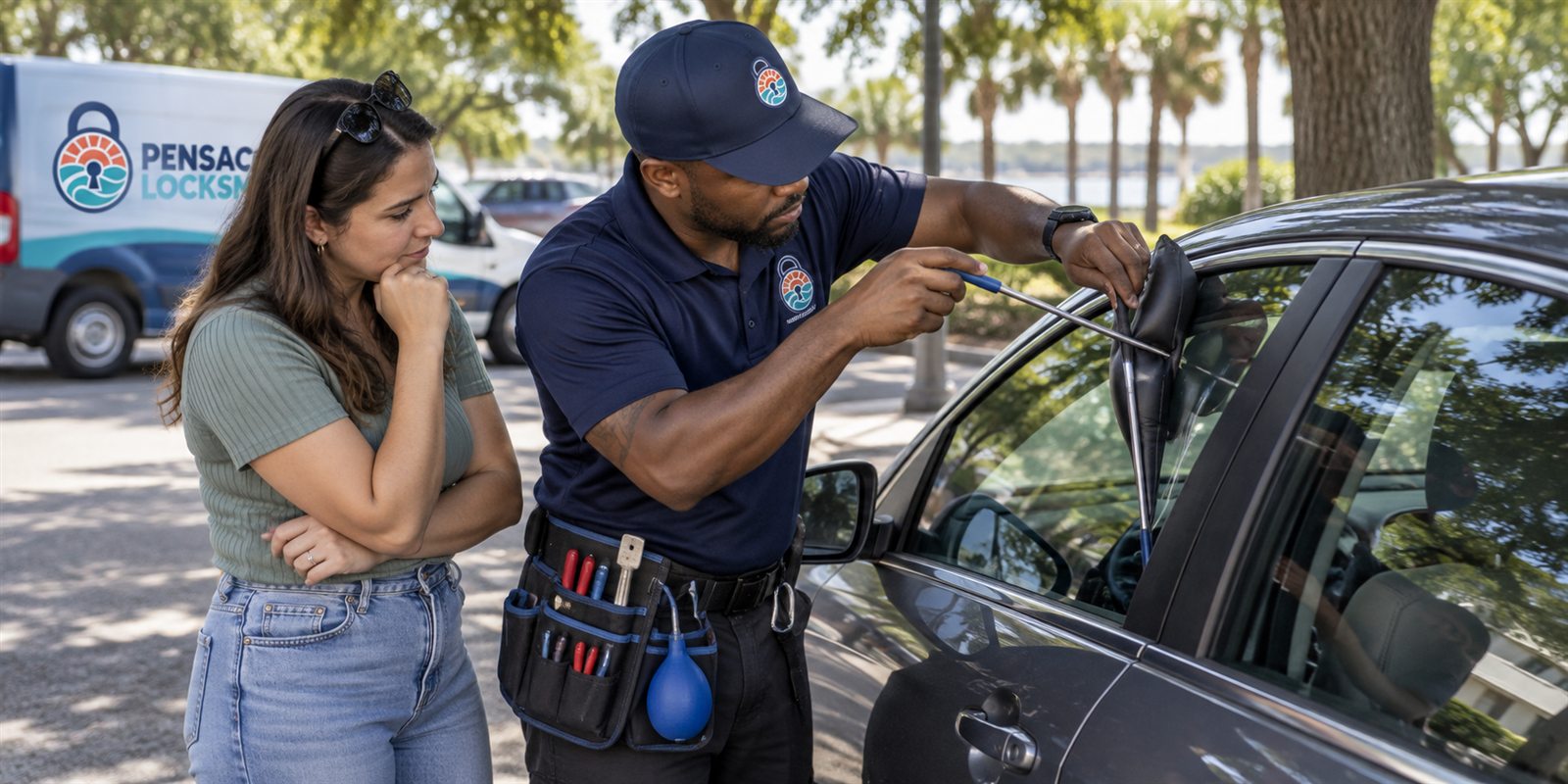
Most smart keys carry a slim emergency blade that slides out of the fob. Owners often forget it exists until the battery dies or the vehicle's door sensors stop responding. That blade fits a keyhole that is usually hidden behind a small cover on the driver door handle. It gives you a way in when electronics fail, and it is worth knowing where it is before you need it.
The blade is cut to the lock pattern for your vehicle, and a locksmith can cut a replacement from the vehicle's key code or by reading the existing locks. Many modern keys use an internal groove cut rather than a simple edge cut, which needs specific cutting machinery. This is one reason a mobile service carries a cutter rather than relying on a pre-cut stock blade for every request.
If you have lost only the emergency blade and still own the fob, that is a smaller job than replacing the whole key. The fob may already be programmed, so only the blade needs to be made and tested in the door. If the fob is also gone, the work becomes a full programming job. Tell us which pieces you still have so the plan matches the actual need.
What we ask you to have ready
Before any key is made or programmed, the locksmith confirms that you are the owner or someone authorized to act for the owner. That usually means showing a government identification and some proof the vehicle is yours, such as the registration or title with a matching name. This step protects you. It also protects every other vehicle owner, since the same tools that help you could be misused by someone else.
Next, the technician needs the vehicle identification number. It is printed on a plate at the base of the windshield on the driver side and on a label inside the driver door frame. The number lets the technician look up the correct key type and, in some cases, the code that tells the cutter how to shape the blade. Having it written down or photographed saves time.
Finally, gather any keys you still have, even ones that do not work well. A worn key can be read and copied, and an existing working key often makes programming simpler. If a key broke in the lock or ignition, keep the pieces. We will ask where the vehicle is parked and whether it is in a garage, a lot, or on a street, because that affects how the technician sets up.
How programming a Lexus key is done step by step
The work begins with confirming ownership and identifying the exact key system. The technician then cuts the emergency blade or the full key, if one is needed, and tests it in the door lock and ignition to make sure it turns smoothly. A badly cut blade can seem fine on the bench and still catch in the lock, so the physical test happens at the vehicle.
Next comes the electronic side. A diagnostic tool is plugged into the vehicle's service port, usually under the dashboard. The tool communicates with the immobilizer, and the technician follows the sequence the system calls for. In some cases the vehicle allows the new key to be added while an existing key is recognized. In others, the system must be told to forget old keys and learn a fresh set, which is a separate procedure.
After enrollment, every function is tested. The technician checks that the engine starts and stays running, that the buttons lock and unlock, and that the trunk release and any other commands respond. If you have more than one key, each is tested. You should leave with every key working and a clear understanding of how many keys the vehicle now knows, so there are no surprises later.
When every key has been lost
Losing the only key is stressful, but it is a normal job. Without an existing key, the vehicle must be convinced to accept a brand new one, and that requires the technician to communicate with the immobilizer directly. It takes longer than adding a spare, because there is no working key to simplify the process, and in some cases the computer must be reset so that the lost key can no longer start the vehicle.
That last point is worth thinking about. If your key was lost in a public place, or you believe someone may have taken it, ask the technician about removing the old key from the vehicle's memory. A lost smart key that is still enrolled could in theory be used by whoever finds it, if they also find the vehicle. Clearing it is a sensible precaution and the technician can explain how it is done.
If the vehicle cannot be moved, or the technician cannot reach the ignition without damage, the plan may change. Sometimes a vehicle needs to be opened first, and that is done with specialized entry tools designed not to scratch paint or bend door frames. Complicated situations may require a technician to visit and assess, and the service call charge is explained before anyone is dispatched. Call us to describe the situation.
Battery trouble that looks like key failure
Many calls about a dead Lexus key turn out to be a tired battery. The small coin cell inside a smart key weakens over time, and the early symptoms are easy to misread. The dashboard may show a message that the key is not detected, the range for unlocking may shrink so you must stand next to the door, or the start button may refuse to respond unless you hold the fob against it.
Many vehicles have a backup method for starting with a weak fob. Typically you press the fob against a certain spot, near the start button or in a console area, so the vehicle can read a chip inside the fob without needing battery power. Your owner's manual shows where that spot is. Trying it first can save a service call and get you to a place where a new battery can be fitted.
Changing the battery is a small task, but it has traps. Pry the case at the wrong spot and the plastic cracks. Install the cell upside down and the fob stays dead. Touch the circuit board with damp fingers and corrosion can start. If you would rather not risk the fob, a technician can change the cell and test the fob at the same visit. Tell us the symptom when you call.
Gulf Coast conditions and the life of your keys
Living near Pensacola Bay and the Gulf means keys spend life in humid, salty air. Moisture works its way into fobs through button gaps and the seam where the case halves meet. Over time the contacts can corrode, buttons lose their feel, and the battery compartment can show a greenish residue. A fob that has been dropped near the beach or carried wet after a swim is especially likely to fail early.
There are simple habits that help. Keep the fob out of a pocket that holds a wet swimsuit or damp towel. Rinse salt from a key ring if it has been splashed, and dry it well. Do not leave a key in a hot parked vehicle through a Florida afternoon if you can avoid it, because heat ages batteries and softens glue inside the case. A small silicone cover also helps keep grit out of buttons.
Hurricane season brings another reason to have a spare. If you are evacuating, the last thing you want is a single key that might be lost in the rush. Having a second programmed key kept somewhere safe at home makes a stressful trip easier. If you live in a rental or vacation property and your keys travel with guests, a spare is even more useful. Call us when you want to plan one.
Spare keys, tradeoffs and good habits
A spare key made while you still have a working key is usually easier than an all keys lost situation, because the vehicle is already cooperating. That is the strongest argument for making one now, before something goes wrong. It also gives you a chance to ask the technician how many keys the vehicle is set to remember and whether a sensible limit applies.
There are tradeoffs to think about. A simple blade key without a remote can be cheaper in effort and parts, but it will not lock the doors by button. A fob with full features is more convenient but contains more that can fail. Some owners choose one full smart key and one plain emergency key kept in a home drawer. We can talk through which setup suits how you actually use the vehicle.
Finally, label and organize. Keep the vehicle identification number somewhere other than the glove box, such as in a phone note, so you can reach it if the vehicle is locked. Keep one spare away from the vehicle at all times. If you sell the vehicle, hand over every key and tell the buyer how many exist. These small habits make any future locksmith visit simpler and more predictable.
Mistakes owners make before calling
The most common mistake is trying to fix a stubborn key by force. Twisting a worn blade in an ignition cylinder can snap it, leaving a piece inside that must be extracted before anything else can happen. If a key feels gritty or sticks, stop and describe what you feel. A technician can often work out whether the cause is a worn key, a dirty cylinder, or a steering lock that is simply engaged against the wheel.
Another mistake is buying several fobs from unknown sellers hoping one will work. Each one may need different programming, and some are made for another market with a different radio frequency. Spending effort on guesswork is understandable when you are stranded, but a quick conversation first usually narrows the choice. Tell us the key type, the start method and what the vehicle displays when you try to start it.
A third mistake is assuming the vehicle must be towed. If the engine will not start only because no recognized key is present, a mobile technician can usually solve it where the vehicle sits. Towing is useful when the problem is mechanical, not when it is about a missing key. If you are unsure which situation applies, call us and describe what happens. We will say honestly when the problem is not a key problem.
Common questions
Can a locksmith make a Lexus smart key without the original?
Yes, in many cases. The technician confirms you own the vehicle, identifies the key system from the identification number, and uses diagnostic equipment to enroll a new fob. It is a longer job than adding a spare, but it is a normal one. Call us with the vehicle details and we will explain what applies to your situation.
Will a fob I bought online work on my Lexus?
Maybe, but appearance alone does not decide it. The frequency, chip family and internal electronics must match what your vehicle expects. Bring or describe the fob and a technician can check compatibility before any work. Used fobs may also be locked to another vehicle and impossible to reuse, so it is worth asking first.
Do you need my title or registration?
We confirm that you are the owner or authorized to act for the owner before cutting or programming a key. That normally means identification plus proof such as a registration or title. This protects you and every other vehicle owner. If you are acting for a family member or a company, tell us when you call and we will explain what is needed.
My fob works only when held against the start button. What does that mean?
It often means the fob battery is weak. Many vehicles read a chip in the fob at close range even when the battery is low, so the engine can start. Replace the battery soon. If a new battery does not fix it, the fob electronics may be damaged and a technician can test it.
Can you come to where the vehicle is parked?
Mobile service is the point of the work. The technician comes to the vehicle in Pensacola and the surrounding Escambia County area, because the vehicle itself must be present for programming. Call us to confirm availability and tell us where the vehicle is. If the job is complicated, a technician visits and the service call charge is explained before dispatch.