
Content note: this page was written by Claude (AI) for Pensacola Locksmith.
Why no keys at all is a different kind of job
Copying a key is easy because you have a working original to follow. When every key is gone, that reference disappears. The technician has to build a key from information the car itself holds, such as its VIN, its lock design and its security data. That is a longer and more careful process, and it is the reason this service is handled separately from a normal duplicate.
It also changes the question of trust. A person asking for a key to a car with no key in hand could be the owner, or could be someone who wants to drive away with a vehicle that is not theirs. Responsible locksmiths treat this seriously. The checks you go through are not a judgment of you, they are what keeps your own car safe from the same request.
The good news is that most vehicles can be handled on site. The technician comes to where the car is parked, whether that is a driveway in an older Pensacola neighborhood, a campus lot or a shopping center, and does the work there. Your car does not need to be towed, unless there is a mechanical problem that has nothing to do with the key.
Step one: confirming that the car is yours
Before anything is cut or programmed, the technician needs to be satisfied about ownership or authority. That usually means a government photo ID that matches the name on the registration or title. The technician also checks that the VIN on the dashboard plate matches the paperwork, and that the plate on the car is consistent with the records you present.
Proof can take other forms. If the car is leased, a lease agreement or a letter from the lender may be needed. If the car belongs to a family member or an employer, a call or written permission from the owner, along with your own ID, can be enough. If a car was recently purchased, a bill of sale and temporary tag may be accepted.
If you cannot get to your documents because they are locked in the car, tell us. Photos of the registration on your phone, an insurance card app, or an email from a dealer or lender may help. The technician will tell you what is acceptable so you can gather it while waiting, and the job stays quick and safe.
Step two: reading the vehicle
Next the technician identifies exactly what the car needs. The make, the general vehicle type, the ignition style and the VIN narrow things down to a key family. They check whether the car uses a traditional blade with a chip, a high-security milled blade, or a push-button smart system. They also note whether the car has a factory alarm or other security.
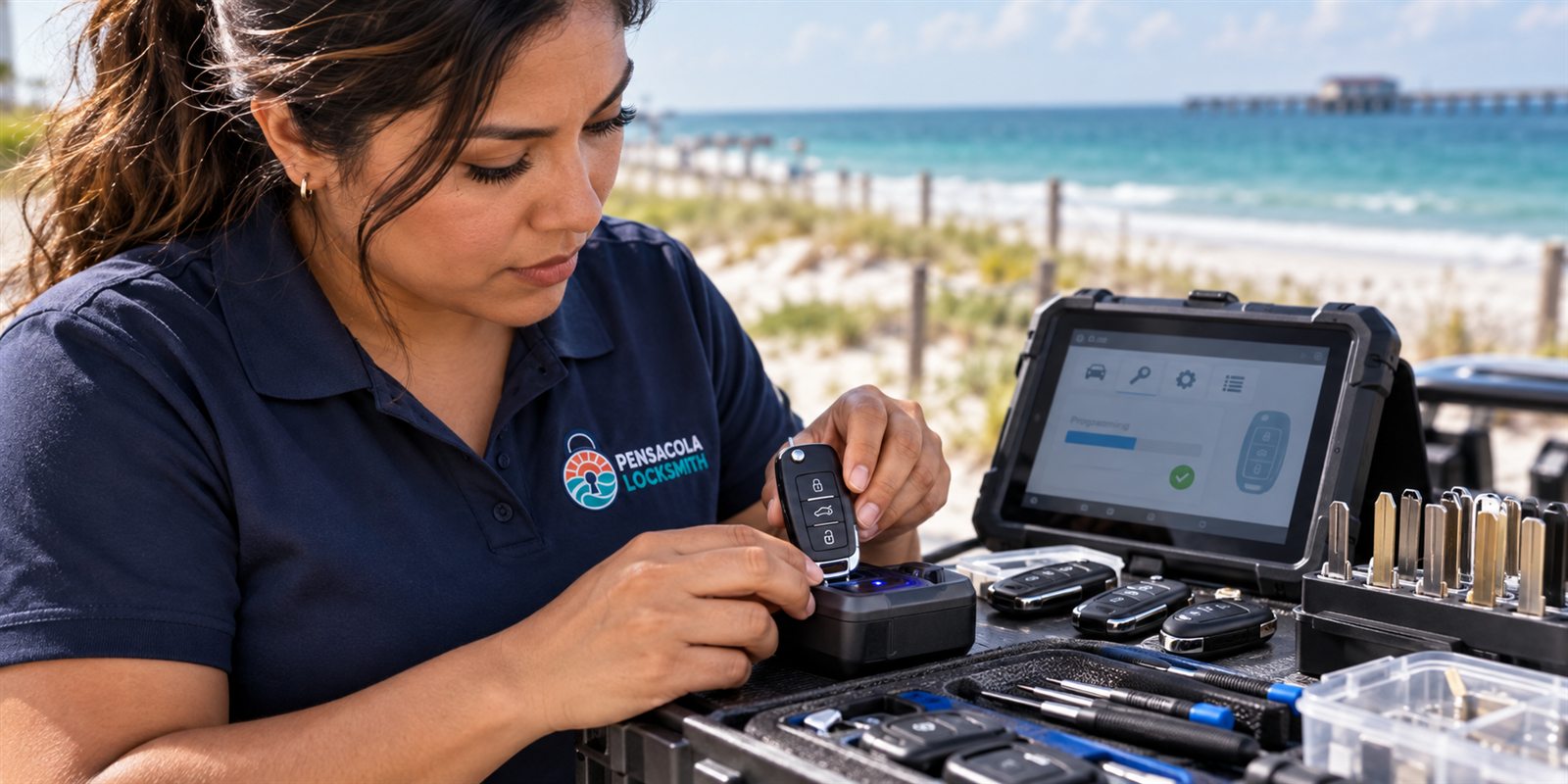
Many cars give up useful information through their data port. A diagnostic tool can read the immobilizer status, confirm how many keys are registered, and tell the technician what level of security access is required. On some vehicles this step is quick. On others, it reveals that a security wait period or special access will be involved.
This stage also shows whether anything else is wrong. A weak battery, a damaged ignition cylinder, or earlier aftermarket work can all affect the process. It is better to discover these before cutting a key, because a perfect key in a damaged ignition still will not start the car, and you will want to know that sooner.
Step three: cutting the first key without a sample
There are several ways to get the shape of a key from the vehicle. If the VIN supports it, the technician can obtain a cutting code that describes each depth. That code feeds a portable cutting machine in the van, and the blade is produced to match. This is the cleanest route when it is available, because the result is a brand new blade with no guesswork.
When a code is not available, the lock can be read directly. A decoder tool or a careful picking process reveals the position of the lock's internal pins, and the technician works out the cuts from that. It takes patience and is used often on doors, trunks and older ignitions. The blade is then cut, test-fitted and filed until it operates smoothly.
Some vehicles use two different sets of cuts, one for doors and one for ignition, or have a valet key that only works in certain locks. The technician cuts the version your situation needs and may suggest a second blade for the other locks. They also test that the cut works in every lock before moving on to programming.
Step four: programming the first key to the car
A cut blade will turn the ignition on some vehicles, but the car will not start until the immobilizer accepts the key. The technician connects the diagnostic tool, selects the vehicle and follows the procedure for adding a key when none exist. Often this involves entering a security code, waiting through a timer, or running a sequence of ignition cycles.
Some vehicles erase all stored keys during this process, which is useful because it means a lost key can no longer start the car. Other vehicles keep the old key list, and the technician may need an extra step to remove the old ones. If a key was lost somewhere you are worried about, mention it so the technician can plan accordingly.
Once programming finishes, the technician tests the key. The engine should start, the dashboard should show no security warnings, and any remote functions should respond. Do not accept a half-finished job. You should leave the visit with a key that runs the car repeatedly, not once, and you should see that yourself.
Smart keys and push-button systems
Vehicles with a push-button start and a proximity key are among the most demanding all keys lost jobs. The car communicates with the fob through encrypted exchanges, and the data protecting that exchange is guarded. The technician needs the right tool and the right access to the car's security module to register a new fob.
In some cases a new fob can be programmed directly. In others, the process requires reading data from a module and creating a key that matches. A few vehicles need a part ordered or access that is not available outside the manufacturer. A responsible technician will say so early, before spending your time and before starting work.
While waiting, there is one thing worth trying if you still have the fob but it has just stopped responding. The battery may be dead, and a hidden backup start method might exist. Check the owner's manual for a spot to hold the fob or a slot for it. That can save a visit, and it makes the difference between a lost key and a low battery.
Step five: planning a spare right away
Once the first key works, the equipment is connected and the vehicle information is already on hand. This is the easiest and most economical moment to add a second key. Without it, a second loss would put you back through every step above. Most people are glad they asked, and most wish they had made the spare long before the first one disappeared.
Choose a spare that is fully functional, with a proper chip and remote, and not a mechanical-only copy. Test it with the engine running. Then store it away from the car, in a place you can reach if the main key fails. A trusted relative, a work locker or a home lockbox are sensible choices, and a magnetic box on the car is not.
Think about everyone who drives. If a spouse, a teenager or an employee uses the car, each may need a key. Programming them all in one visit is simpler than several separate trips. Tell us how many keys you want when you call, so the technician can bring the right number of blanks and plan the time.
What can slow the job down
Several things can lengthen an all keys lost visit. A car with a dead battery cannot be programmed until power is stable, and the technician may need to jump or support the battery. A damaged or heavily worn ignition cylinder can prevent the new key from turning and may need repair or replacement before the process can finish.
Some vehicles have mandatory security delays, where the car refuses to accept a new key until a period has passed. This is a built-in protection, and it cannot be skipped. The technician will wait with you. It helps to keep the car's doors closed, the lights off and the area quiet so the car does not time out or reset.
Another delay comes from paperwork. If proof of ownership is not at hand, the technician cannot proceed. That is not a lack of trust, it is the process. Reaching a family member who can send the registration, or finding an email from a lender, often solves it quickly. Collect what you can before calling, and the visit will move along.
Safety and sensible waiting
While you wait, make sure you are in a safe place. If you are in a parking lot at night, stay in a lit area and tell someone where you are. In summer, find shade, drink water and avoid sitting in a closed car. The Gulf Coast heat is intense, and an unprepared wait can become uncomfortable quickly.
If your keys may have been stolen, as opposed to simply lost, treat it as a security matter. Anyone with the key and the car's location could drive it away. Contact local authorities, and consider telling the technician so that the old keys can be removed from the car's memory when the new key is programmed.
Also think about other things on the lost key ring. House keys, a mailbox key, a work badge and a garage remote may all be gone. If your home address is on anything attached, rekeying the house may be wise. We cover that on our rekeying page, and the technician can talk through whether it makes sense in your case.
When the car has already been towed or is not at home
Many people call after the car has already been towed to a shop or a lot. A mobile technician can often still come to that location, provided the lot allows it and you can show ownership. Check with the facility first, because some lots restrict outside work. Having the facility's permission avoids a wasted trip.
If the car is parked in a spot you cannot reach, such as a marina lot or a beach access area, tell us where. We will plan around access and safety. Cars in tight garages or on soft sand present their own challenges, and moving the vehicle to a firmer and safer place beforehand, if possible, helps the technician work.
For vehicles left at a vacation rental, a campus, or a base-adjacent lot, ask whoever manages the space whether outside service is allowed. In most cases it is, but a quick check saves time. Give us accurate directions and a contact number for anyone who needs to let the technician in, and the visit goes smoothly.
Before you call: a short checklist
A few minutes of preparation can shorten the whole visit. Write down the make, the general type and the color of the car, and the exact place it is parked. Photograph the VIN plate at the lower corner of the windshield and keep the picture handy. If you know whether the car starts with a button or a key, note it.
Gather proof of ownership: a photo ID, the registration or title, and any lease or lender paperwork. Digital copies are useful when the originals are locked in the car. If someone else owns the car, arrange for them to be reachable by phone, since the technician may need to speak to them or see a message from them.
Think about the keys themselves. Do you remember when and where you last had them? Is it possible they are at home, at work or in another jacket? Spending ten minutes on a careful search can save a visit. If you find a spare, a technician can often use it to make the process faster and simpler.
Finally, decide how many keys you want. A first key gets you moving, and a second protects you from a repeat. If more than one person drives the car, count them. Share this with us when you call, and we will explain what the visit involves and confirm availability for your location.
Understanding the trade-offs in cost and time
All keys lost jobs take longer than a simple copy, because every step is built from scratch. There is more checking, more cutting and more programming. That naturally affects the service call charge, which is explained before dispatch whenever a visit is needed. We do not guess figures here, because they depend on the vehicle and the key type.
Dealerships and other routes exist, and some people choose them for good reasons. The trade-off is usually logistics. If the car cannot move, a tow is involved, and a key may need to be ordered. A mobile visit avoids those steps for most vehicles, but there are cases where a part must be sourced, and we say so honestly.
Time depends on the car. A vehicle with a straightforward chip and no security delay can be finished quickly, while a smart key system might take longer. We avoid promising arrival times or job durations. Instead, call us to confirm availability, and the technician will give you a realistic picture once the details of your car are known.
One more consideration is what happens afterward. If the lost keys had your home address, think about changing locks at home as well. A new car key solves the car problem, but it does not solve the question of who might have your house key. We are glad to talk through both on one call.
Common questions
Can you really make a key if I have none?
In most cases, yes. The technician confirms ownership, reads the VIN and the vehicle's security information, cuts a blade from a code or from the lock, and programs the first key to the car. Some vehicles have extra restrictions or need parts, and we tell you on the phone if yours is one of them.
What proof of ownership will I need?
Usually a valid photo ID that matches the registration or title, along with the plate or VIN on the car. If the car is leased or belongs to someone else, a lease document or the owner's permission may be needed. We explain exactly what is acceptable when you call, so you can gather it while you wait.
Will the lost key still be able to start my car?
That depends on the vehicle. Many cars let the technician remove old keys from memory when a new one is programmed, which stops the lost key from working. Others keep the earlier list. Tell the technician if the key may have been stolen, and the options for your specific car will be explained.
Does the car need to be towed?
Usually not. The technician brings cutting and programming equipment to the car, so it can be handled where it is parked. The exception is when there is a separate mechanical problem, such as a damaged ignition or a dead battery that cannot be supported. Describe the situation on the call and we will tell you.
How do I find out the cost?
Quotes are given by phone once we know the vehicle and what it needs. For complicated jobs, a technician visits and the service call charge is explained before dispatch. Call us to confirm availability and we will walk through the steps, what to prepare, and what the visit will involve before anything begins.