
Content note: this page was written by Claude (AI) for Pensacola Locksmith.
Why doors and locks matter more than people think in a storm
A hurricane tests a building at its openings. Wind pressure pushes against doors and tries to peel them from their frames, while rain drives into every gap. A door is only as strong as its weakest part, and that is often the latch, the strike plate or the screws holding them. When a door fails, wind enters the structure, and the damage multiplies.
Locks also decide who can get in after the storm. Neighbors, relatives and emergency workers may need to enter a home. Owners returning after an evacuation want to get inside quickly to assess damage. If keys are lost, locks are jammed or doors are warped, everyone loses time at a stressful moment.
The good news is that most lock preparation is simple. You do not need special equipment. You need to know where the keys are, whether the doors close properly and whether the hardware is in good condition. Doing this check in late spring, before the season gets going, is much easier than doing it with a storm named and approaching.
Checking the hardware on your doors before the season starts
Start with a walk around the house, trying each exterior door. Open it, close it and lock it. Does the deadbolt extend fully into the strike plate? Does the door need to be lifted or pushed to latch? Any binding or misalignment means the door is not seated properly, and under heavy wind that matters.
Look at the strike plate and hinges. In many homes the strike plate is held by short screws that only bite into the thin door jamb. Replacing them with longer screws that reach the wall framing strengthens the whole assembly, and costs very little. Check hinge screws too. A door whose hinges are loose will flex in strong wind.
Also look at the lock itself. A deadbolt that feels gritty or sticky may be corroded inside. Salt air and humidity are hard on cylinders, and a lock that struggles in good weather may fail in a storm. A technician can clean, rekey or replace a worn lock. Call us before the season to talk through anything that does not feel right.
- Test every exterior door, including garage entry and patio doors
- Replace short strike plate screws with longer ones
- Look for sticking, gritty or loose locks and hinges
- Check that sliding door latches and track locks engage fully
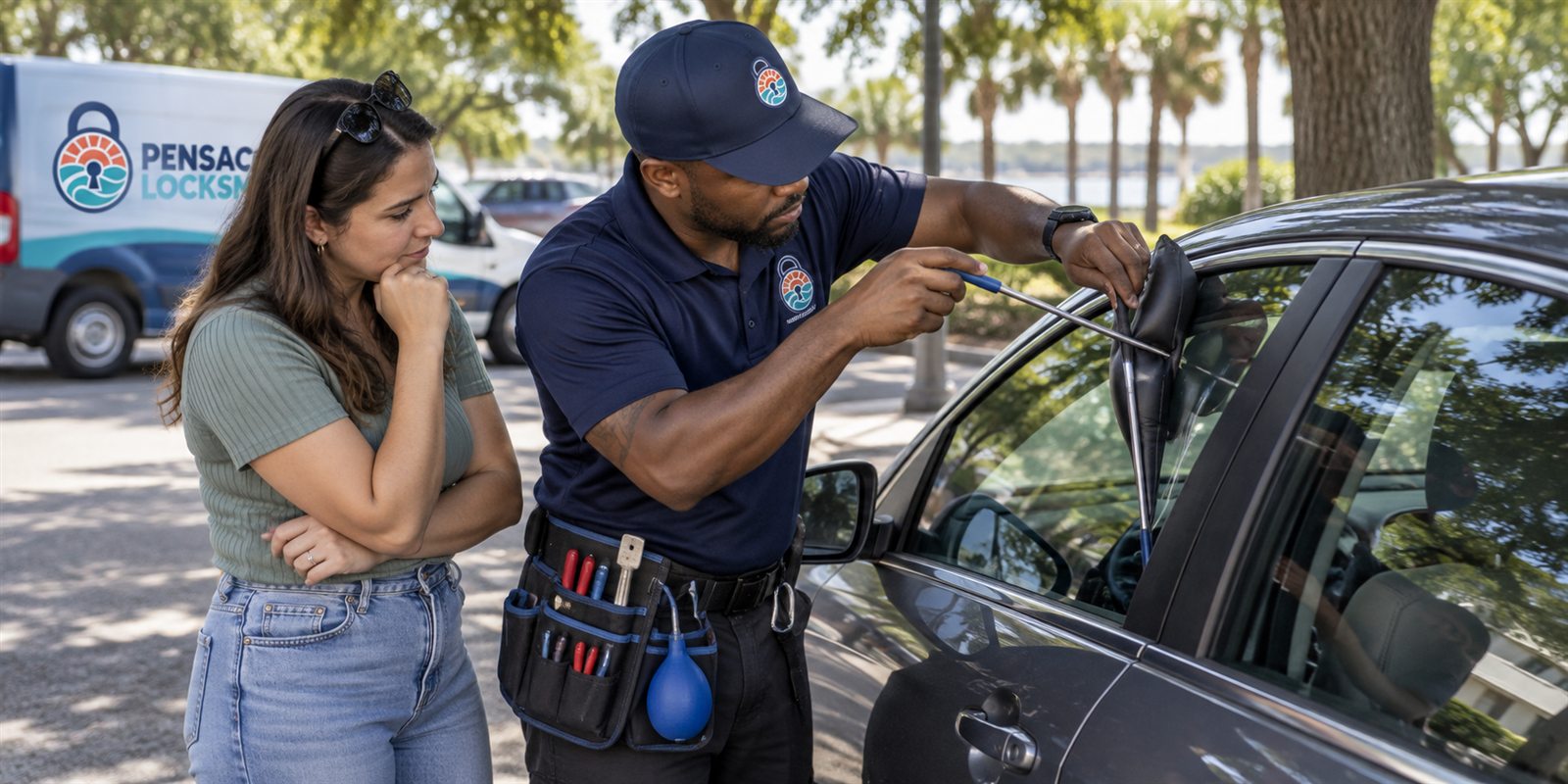
Sliding doors, garage doors and the weak points
Sliding glass doors are among the weakest openings in a house. Their latches are often simple hooks, and the door can lift off its track under pressure. Installing a secondary lock, such as a pin or a bar in the track, adds resistance. Impact-rated doors and shutters are another matter and are not a locksmith's job, though your lock choices should work with them.
Garage doors deserve attention too. A large door is a big sail that wind can push inward. The tracks, the brackets and the locking arm all matter. Some garage doors have a slide lock or a bolt that engages the track, which you can use before a storm. Check that it moves freely and that you can reach it without a ladder.
The door between the garage and the house should be treated as an exterior door, with a solid latch and a deadbolt. Side doors, service doors and gates should be inspected the same way. If a door cannot be made to close properly, ask a contractor or a carpenter about the frame. A locksmith can handle the lock and the strike, but a warped frame needs another trade.
Keys, spares and a plan for finding them
Evacuation is a poor time to search for keys. Before the season, gather the keys you might need: house, car, outbuildings, mailbox, safe and any lock you may have to open in a hurry. Put them in a place you can grab quickly, such as a labeled pouch in your go bag. Keep a duplicate set somewhere off the property, with a relative or a trusted friend.
Check that spare keys actually work. A copy of a copy can be a poor fit, and a key that has not been tried for years is a gamble. If a key is rough or does not turn smoothly, have a new one cut from the original. For vehicles with chip keys or fobs, test the spare, because a dead battery in a fob is easy to overlook.
Take photos of your important documents, including registration and identification, and store them in a secure place. If your keys are lost or damaged after a storm, a locksmith will need to confirm your ownership or authority before making new keys or opening locks. Having proof ready speeds things up when many people need help at once.
Padlocks, gates, sheds and outdoor hardware
Outdoor locks live in a hard environment even without a hurricane. Salt, rain and heat attack padlocks, hasps and gate latches. A padlock that is sticky in June may seize entirely after a storm soaks it. Replace weathered locks with models designed for outdoor use, and keep a little lubricant suited to the job on hand.
Before a storm, secure what you can. Lock sheds and gates, so doors do not swing loose and become projectiles. Check that hasps are firmly attached with screws that go into solid material, not into thin siding. If a gate has a drop bolt, make sure it engages the ground or the post fully.
Think also about valuables stored outside. Tools, generators and boats are tempting targets after a storm, when security is stretched. If you have an outbuilding, consider a stronger lock and a more secure hasp. A locksmith can rekey several padlocks to one key, so you carry one instead of a ring. Call us, describe your property, and we will suggest what is worth upgrading first.
If you evacuate: locking up and leaving a clear trail
When you leave, lock every door, including the ones you rarely use. Double-check the garage entry, sliding doors and windows that have latches. Take your keys with you, and keep a key with a trusted person who can check on the house if the roads allow. Tell that person what you want done if something is damaged.
Think about what a returning crew will need. If a relative or contractor must enter, they need a key, or a lockbox with a code. Write down who has access and for what purpose. Keep the arrangement simple, and remove the temporary access once the emergency is over. A lockbox with a code you change afterward is a reasonable option.
Do not leave a key hidden outside in an obvious place. After a storm, people may be wandering through neighborhoods, and well-known hiding spots are well known. If you cannot take a key to a trusted person, a lockbox bolted to a solid surface is safer than a rock or a plant pot. If you have questions about secure ways to share access, call us.
After the storm: inspecting locks and doors safely
When you return, put safety first. Do not enter a structure that looks damaged or unstable. Watch for downed lines, broken glass and standing water. Once it is safe to be inside, check the doors and locks before relying on them. Wind and water may have moved frames, bent latches or filled cylinders with debris.
Water and salt are the main concerns. Locks that were soaked often corrode quickly. Rinse exposed hardware with fresh water if you can, dry it and apply suitable lubricant. A stiff lock should be worked gently. Do not force a key. A broken key in a cylinder is a more costly problem than a stiff lock that needs service.
Check that each door closes and latches cleanly. A door that has shifted may rub or fail to line up with the strike. Small adjustments can sometimes fix it, though a damaged frame needs a carpenter. If the home cannot be secured, temporary measures such as a brace or a board may be needed until repairs are possible. Document damage with photos for your records and your insurer.
When you are locked out or cannot secure the property after a storm
After a major storm, lockouts and damaged locks become common. Keys are lost, doors jam, and some residents return to find a door forced or a lock destroyed. In that situation a mobile locksmith can open locked doors, replace damaged hardware and rekey locks. Demand can be heavy, so patience is needed.
Because the demand is high, be prepared. Have your address, a description of the door and lock, and proof that you live there or own the property. A technician confirms authority before opening or changing a lock. That applies even in an emergency, and it protects you from someone claiming a door that is not theirs.
Call us to confirm availability, and explain what is happening. If the property cannot be left unsecured, say so. Quotes are given by phone. If the job is complicated, such as a damaged frame with a broken lock, a technician visits and the service call charge is explained before dispatch. We cannot promise timing during a widespread emergency, and we will tell you honestly what is possible.
Vehicles, flooded cars and key problems after a storm
Vehicles suffer after storms too. A car that sat in standing water may have damaged electronics, including the key fob and the door lock actuators. Do not try to start a flooded vehicle. Water in the engine or electrical system can cause serious damage if the motor is cranked. Call a tow service or a mechanic first.
Key fobs and chip keys that got wet may stop working. Let them dry thoroughly and replace the battery before assuming the fob is dead. If the fob is damaged, a locksmith may be able to cut and program a replacement, depending on the vehicle. Ownership documents are checked first, which can be hard if papers were lost, so keep copies elsewhere.
Door locks that were submerged may become stiff or fail to respond. Power locks can lose function, leaving the door to be opened by the key cylinder. If the cylinder is corroded, it may need cleaning or replacement. Do not force anything. Call us, describe the vehicle and what you see, and a technician can tell you whether the job is within our scope or needs a dealer or body shop.
Businesses, rentals and shared buildings in storm season
Business owners face extra lock questions. A shop that closes ahead of a storm needs to be locked securely, with keys accounted for and a plan for who can return first. Roll-up doors, rear service doors and storage rooms should all be tested. Alarm systems and electronic access may lose power, so keep a mechanical backup, such as a keyed override.
Owners of rentals and vacation properties have another worry: guests or tenants who may have left in a hurry. After an evacuation, check that all doors are locked and that no keys or codes are floating around. Changing keypad codes after the storm passes is easy and reduces risk. Rekeying is worth considering if you do not know who holds copies.
In condos and shared buildings, the association usually controls common area locks. Boards should know where the master keys are and who can reach them. A locksmith will confirm authority before opening anything on behalf of a business, rental or association. If you manage property, collect proof of your role in advance, and call us to talk through a plan before the season gets busy.
Generators, power loss and electronic locks
Power outages can last days after a hurricane, and many modern locks depend on electricity or batteries. Keypad deadbolts, smart locks, electronic gates and garage door openers all behave differently when power is out. Some keep working on batteries, some fail locked and some fail open. You should know which behavior your hardware has before you need it.
Check the batteries in keypad and smart locks at the start of the season, and keep spares in your supplies. Know where the mechanical key override is and test it. A smart lock with a dead battery and no key is a bad combination during an evacuation return. For garage doors, learn how to disconnect the opener and lift by hand, and make sure the door is not locked in a way that prevents it.
If you run a generator, keep it secured. They are valuable and in demand after storms. A chain and padlock through the frame to a fixed object adds protection, as long as the generator is used outdoors and far from windows and doors, following the maker's instructions. A locksmith can suggest a lock setup for your generator and sheds. Call us to talk through electronic and mechanical backup choices.
A simple seasonal checklist you can use every year
A routine beats memory. Each spring, before the season starts, run through the same list. Test all exterior locks, check strike plates and hinges, cycle the sliding door latches, test the garage door lock and review your spare keys. Write down anything that needs work and schedule it before the busy months.
Update your key plan as well. Make sure someone off the property has a set. Check fob batteries on vehicles. Review who has access to your home and whether anyone no longer should. If a key has been lost or given out loosely over the year, consider rekeying. It is far easier to do in calm weather than during a crisis.
Finally, save the locksmith's number somewhere you can find it without internet, such as a written list in your go bag. When a storm has passed and phones are stretched, a printed number helps. Call us to confirm availability and to ask questions at any time of year, and use these quiet months to prepare so the season holds fewer surprises.
Common questions
What lock checks matter most before a hurricane?
Test every exterior door, confirm the deadbolt extends fully, and replace short strike plate screws with longer ones that reach the framing. Check sliding door latches and garage entry doors. Gather your keys in one place and leave a spare set with someone off the property.
Should I leave a spare key hidden outside when I evacuate?
Avoid obvious hiding spots, since they are well known. A better choice is to leave a key with a trusted person or use a lockbox bolted to a solid surface, and change the code afterward. Keep a simple record of who has access.
My locks are stiff after the storm. What should I do?
Rinse exposed hardware with fresh water, dry it and apply a suitable lubricant. Work the key gently and do not force it. If the lock does not improve, call us before it breaks. A cleaned or replaced cylinder costs less than dealing with a broken key.
Can a locksmith help if my door is damaged and will not lock?
Often yes, for the lock, latch or strike. A warped frame may need a carpenter. We confirm your ownership or authority first. Call us to confirm availability, since demand can be high after a storm, and describe the damage so we can plan the visit.
Can I start a car that was in floodwater?
Do not try. Water in the engine or electrical system can cause serious damage if the motor is cranked. Call a tow service or mechanic first. If the key fob stopped working, dry it and replace the battery, and call us if a replacement is needed.