
Content note: this page was written by Claude (AI) for Pensacola Locksmith.
Why beach parking lots cause so many lockouts
Beaches are rough on keys and drivers alike. People arrive with chairs, coolers, umbrellas and children, and in the shuffle of unloading, a key set down on the roof or the passenger seat gets locked in when the doors are closed. Many modern cars lock automatically when the driver walks away with the fob, or when the doors are shut with the keys inside and a button pressed.
Swimming makes it worse. Few people want to carry a key fob into the water, so keys end up hidden under a tire, in a bag on the sand, or left in the car in the belief that it is safe. A wet fob can fail, a buried key can be lost, and a bag left unattended can be taken. All of those create a lockout of one sort or another.
Then there is the environment. Sand finds its way into key fobs, door handles and door locks, and salt air attacks metal parts and electrical contacts. A key that worked fine at home may stick at the beach, and a door lock that is stiff from corrosion can jam. The result is a car that will not open for reasons that have nothing to do with the driver's care.
First checks before you call anyone
Start by trying every door and the trunk. It is easy to assume the car is fully locked when only the driver's door is, and a rear door or hatch may have been left open. If you have a spare key, ask whether someone in your group, a family member nearby or a friend can bring it. A spare fob in a purse or a second set in a hotel room could save time.
Check whether your car has a phone app, a keypad on the door, or a connected service that can unlock it remotely. Many newer vehicles have such features, though you must have set them up earlier. Some insurers and roadside programs include lockout help, and your insurance card or app may list a number. Make that call if you have the coverage.
Do not use force. Wedges, coat hangers and prying tools can scratch paint, tear weather seals, bend door frames and damage the wiring and airbag components inside the door. A professional lockout tool is designed to avoid those problems. If anything on the car looks damaged or unusual, tell the technician when they arrive.
Heat, children and pets: when it is an emergency
A car on the Gulf Coast in summer becomes dangerously hot in a short time, even with a window cracked. If a child, a person who is unwell or a pet is inside a locked car, this is an emergency. Call emergency services immediately. Do not wait for a locksmith, and do not spend precious minutes trying alternatives. Responders can enter the car quickly.
If the people or animals are outside the car with you, move everyone into shade, offer water, and keep them out of direct sun while you wait. Sand and pavement can be hot enough to burn bare feet, and a lot of beach lots have little shade. Consider walking to a nearby shop, a pavilion or a covered area, and let someone stay with the vehicle.
Heat also matters for you. Long waits in the sun can lead to dehydration and heat illness. Keep hats and sunscreen handy, and drink water. If your wait may be long, think about calling a friend or family member to bring supplies. A calm, comfortable wait is better than a rushed decision made out of discomfort.
Proving the car is yours
A responsible locksmith confirms ownership or authority before opening a vehicle. On a beach trip, your wallet may be locked in the car or in a bag, which complicates matters. Photos on your phone of your registration, insurance card and driver's license can help. The name on the documents should match your ID, and the vehicle identification details should match the car.
If you are driving a rental or a borrowed car, explain that when you call. The rental company or the owner may need to authorize the work, and a technician can speak with them directly. This protects the owner and avoids problems later. A friend's car needs the friend's permission, which can often be given by phone.
The check is not a trick. A person who really owns the car can usually pass it with little trouble. It is meant to stop someone opening a car that is not theirs. If you cannot produce proof straight away, tell us, and we can discuss what other evidence might work, such as the key code, the owner on the phone or an insurance record.
How a locksmith opens a car without damage
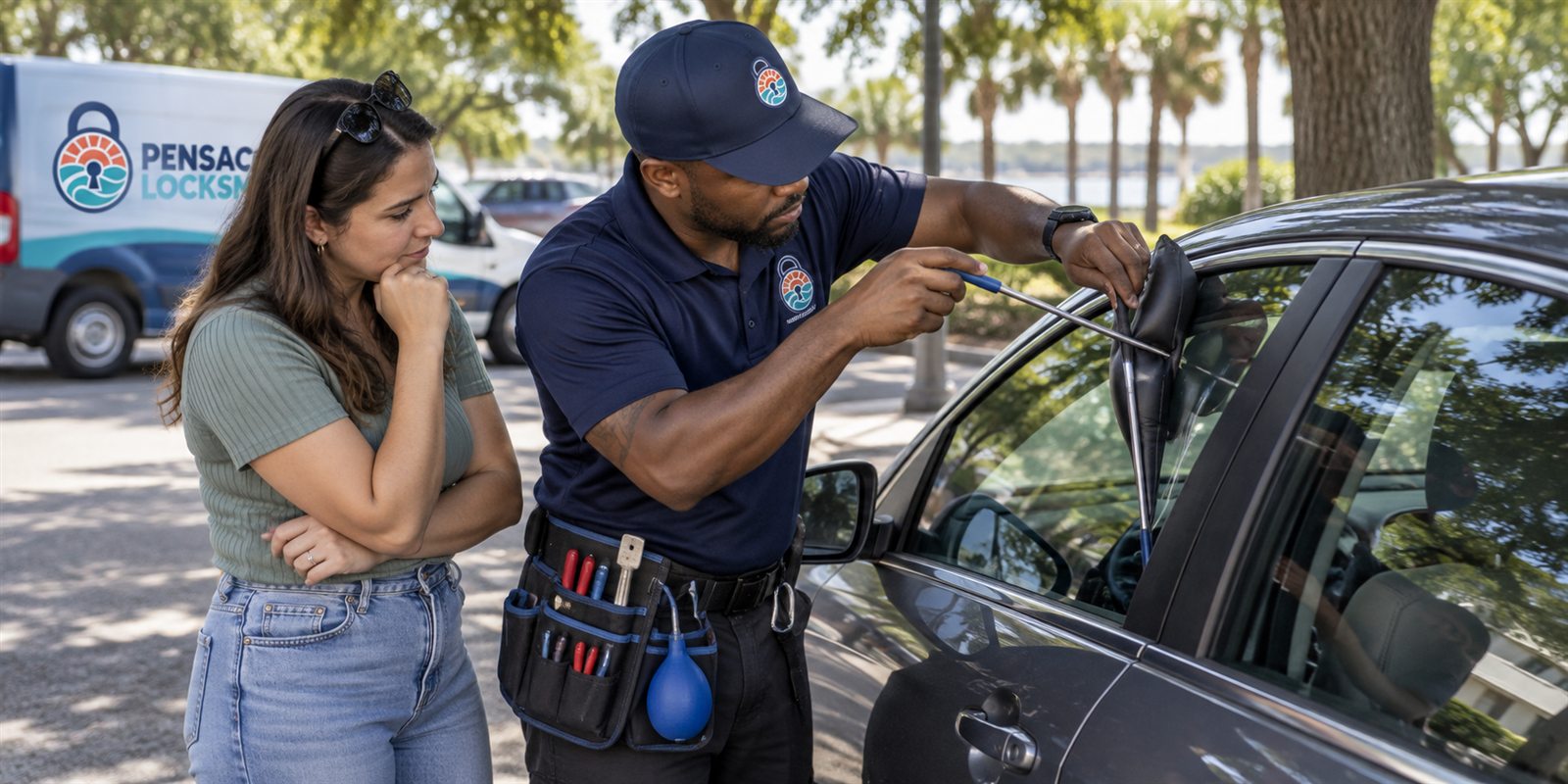
Professional lockout work relies on purpose-made tools. A thin, strong wedge creates a small gap at the door, and a long reach tool passes through to press the unlock button or pull the handle. Technicians choose the approach by vehicle type, because some doors, especially in newer cars, have more delicate weather stripping and wiring. Done carefully, there should be no damage at all.
Different cars call for different methods. Some have a mechanical lock that can be reached, others use an electronic lock operated from a button. Frameless windows, side airbags and sensors in the door call for care, and a technician who knows the vehicle will avoid the risky areas. If a car is particularly difficult, a technician may discuss options with you before proceeding.
Once the door is open, check that everything works: the lock, the window, the door seal. If the keys were locked inside, retrieve them and test them. If the lockout happened because of a damaged lock or a failing fob, mention it so the technician can look at the cause. Fixing the cause avoids a repeat visit on your next trip.
Sand, salt and fobs: why keys fail at the beach
Key fobs are small electronics, and the beach is hard on them. Moisture can reach the circuit board and the battery contacts, causing erratic behavior or complete failure. If a fob has been wet, dry it as well as you can, avoid pressing the buttons repeatedly and let it rest. Rice is a common suggestion, but a dry, warm, airy place works better than a bag of grains.
Sand acts like grit in a hinge. It enters buttons, battery covers and the keyway of the mechanical key. A gritty key forced into a lock can scratch the cylinder and wear the key. If the key feels rough, wipe it and the lock opening, and try again gently. If it will not turn, do not force it. A bent or broken key in a lock turns a small problem into a larger one.
Know your backup. Most fobs contain a mechanical key hidden inside, and most cars with push-button start have a place to hold the fob near the button to start if the battery is dead. Check your manual before you need it. Keeping a spare key at home, and not in the car, gives a safety net that does not rely on the beach conditions.
Where to keep keys when you swim
Plan before you leave the car. Decide where the key will be, and make it a deliberate choice. The safest option is to leave the keys with someone who stays on the beach, in a zipped pocket or a dry bag that does not leave your sight. Hiding keys in the wheel well or bumper is a bad habit, because thieves know the spots.
Waterproof pouches and floating key holders are sold for this purpose and work well. They keep moisture out and let you carry the key to the shoreline. For fobs, a waterproof pouch matters even more, since the electronics are what fail. Some people prefer to leave the smart fob at home and carry a basic mechanical key for the beach.
Never leave valuables visible in a parked car. Beach lots are targets, and a locked car with a bag in sight invites a break-in. Put items in the trunk before you arrive at the lot, not once you are parked, so that no one watching sees where you stash them. A neat, secure car is less likely to cause trouble in the first place.
Broken keys, stuck locks and dead batteries
Not every beach problem is a simple lockout. A key may break in the lock, the ignition may refuse to turn, or the car may not start at all. A broken piece in a door lock needs to be extracted carefully, and a technician has extractors to remove it without further damage. Do not try to push it through or use glue, which makes extraction harder.
A steering wheel that locks up or an ignition that sticks can be mistaken for a lockout. Gentle movement of the wheel while turning the key sometimes frees it, but do not force. A worn key can behave like a bad key even when it looks fine, and a key copied many times may lose accuracy. Mention it when you call.
A dead car battery makes electric locks and fobs unreliable. If your fob works only up close or not at all, the car battery may be the problem. In that case, a jump start or a battery replacement may be what you need, and a locksmith may not be the right call. We can still tell you what we think over the phone and help you decide.
Crowds, traffic and working safely in a busy lot
Beach lots on a busy day are tight, with cars circling for spaces, families crossing with gear and little room to maneuver. A technician needs access to the car, enough room to open the door and a safe place to work. If you can, stay with the vehicle and be ready to direct traffic politely or to move a cone or chair that signals the spot.
Tell the technician about any restrictions at the lot, such as paid parking, a time limit or a gate. If the car is blocking a lane, the technician may need to work quickly, and you may need to move other belongings. Being ready with the details avoids delays. Keep children and pets back from the working area, particularly with sharp tools and moving cars around.
Be mindful of your own belongings. When the door opens, check that nothing was taken from the car, particularly if it was left visible. Take your keys, phone and wallet and lock the vehicle again as soon as it is safe. If you see signs of tampering, such as a damaged lock or a broken window, tell the technician and consider contacting the authorities.
Getting a spare key made after a beach lockout
A lockout is a good moment to fix the cause. If you had only one key, get a spare made soon. For many cars, especially those with a transponder chip, a copy must be programmed to the vehicle, and the process needs the right equipment. A cut-only copy may open the door but fail to start the engine. Ask about programming before assuming a quick duplication will do.
If your fob is worn, cracked or unreliable, replacing it before the next summer is sensible. A replacement involves matching the vehicle and programming the new fob. The locksmith confirms ownership before programming. Call us with the vehicle details, and we explain the process and give a quote by phone. For complicated vehicles, a technician visits and the service call charge is explained before dispatch.
Store the spare well. Keep it somewhere safe at home, not in the car, a beach bag or a pocket of the same jacket as the main key. Some owners give a spare to a trusted relative. Having two keys in two places is the single best defense against a beach lockout, and it protects you whether the trouble is sand, water or plain forgetfulness.
What to expect when you call us
When you call, tell us where you are, which beach lot or street, and describe the car: make, model and color. Say whether the keys are inside, lost or broken, and whether anyone is at risk. We give a quote by phone, so you know the cost before a technician heads your way. Please call to confirm availability, since beach weekends are busy.
If the situation is complicated, such as a damaged lock, a broken key in the cylinder or a vehicle that needs special handling, a technician visits and the service call charge is explained before dispatch. We would rather be clear up front than surprise you at the car. If something changes on site, the technician will explain it before continuing.
On arrival, the technician confirms ownership or authority, assesses the door and opens the vehicle with care. They can also check the key and fob, and if needed, make a replacement or program a new fob. Afterward, take a moment to test everything and ask questions. A calm, clear process makes a stressful day a lot easier.
A simple beach day plan for drivers
Before leaving home, give yourself a short checklist. Do you have a spare key at home or with someone you trust? Is the fob battery in good shape? Do you have a waterproof pouch? Are your registration and insurance photos on your phone? Is your phone charged? These small steps take a minute and spare you a long hot wait.
At the lot, form a habit. Keys go in the same zipped pocket, every time. Check for them before you close the door, and do not rely on the car locking itself with the fob inside. If you have a keypad or app, test it before you need it. Tell a companion where the keys are and who holds the spare.
After the beach, rinse sandy gear away from the car, and wipe the door handles and fob. Salt and sand left on a lock will cause trouble later. If anything feels stiff, deal with it soon. A cheap bit of care now saves you from a gritty lock the next time you pull into a beach lot with a cooler in your arms.
Common questions
Can you open my car if the keys are inside?
Usually yes. A technician uses professional tools to open the door without damage once ownership or authority is confirmed. Have your registration and photo ID ready, even as photos on your phone. Quotes are given by phone, and you should call to confirm availability.
What if a child or pet is locked in the car?
Call emergency services right away. Heat in a closed car is dangerous within a short time, and responders can enter immediately. Do not wait for a locksmith in that situation.
My fob got wet and stopped working. What now?
Dry it as well as you can, avoid pressing the buttons, and use the hidden mechanical key to open the door. Try the backup start method in your manual. If it still fails, a technician can test it and replace or reprogram it.
I lost my wallet and registration in the locked car. Can you still help?
Possibly. Photos of documents on your phone, a call to the owner or an insurance record can help confirm authority. Tell us your situation when you call and we will explain what is needed.
Will opening the car damage it?
Professional methods are designed to avoid damage to paint, seals and wiring. Techniques vary by vehicle, and the technician will explain anything unusual first. Avoid prying or using hangers yourself, which is how most damage happens.