
Content note: this page was written by Claude (AI) for Pensacola Locksmith.
The look of an Audi key and what it tells us
A glance at your key gives a technician a lot of information. A key with a folding blade that swings out of a remote body belongs to one family of systems. A flat fob with no exposed blade, used with a start button, belongs to another. Shape, button layout and the finish of the case all hint at the generation of the vehicle and the security system behind it.
That said, appearance can mislead. Two fobs that look nearly identical might use different radio chips, and a fob designed for one market may not talk to a vehicle built for another. The identification number remains the dependable guide, and a technician reads it before choosing parts. Do not buy a fob online on the strength of a photograph.
When you call, describe your key in your own words: whether the blade folds, how many buttons it has, whether the vehicle has a start button or a key slot. Mention any damage, such as cracked plastic or a missing button cover. Photos help. The more precisely you describe the starting point, the better a technician can plan, and the less time is spent at the vehicle on surprises.
How the security behind the key is organized
Behind the key sits a security design intended to keep the engine from running without a valid, registered key. A coded chip or an encrypted fob answers the vehicle's challenge, and several modules compare notes. If all agree, the engine is allowed to run. If any disagree, the vehicle may unlock but not start, or may start briefly and shut down.
This is why cutting a blade is not enough, and why a fob bought elsewhere often fails. The new key has to be introduced into the vehicle's memory in a way that the vehicle accepts, and some systems demand that a specific security data set be read or entered. The procedure differs from one family to another, and some are more open to independent technicians than others.
For the owner, the practical meaning is that there are three outcomes. Many Audi key jobs are done on site by a mobile technician without trouble. Some need extra steps or time. A few depend on resources that only the maker's own channels provide. We will tell you which category your vehicle seems to fall into after the first questions, and we will not make promises we cannot keep.
- Blade key with a folding remote
- Flat proximity fob for push button start
- Chip key on older vehicles
- Emergency blade hidden inside the fob
Ownership and authority, checked every time
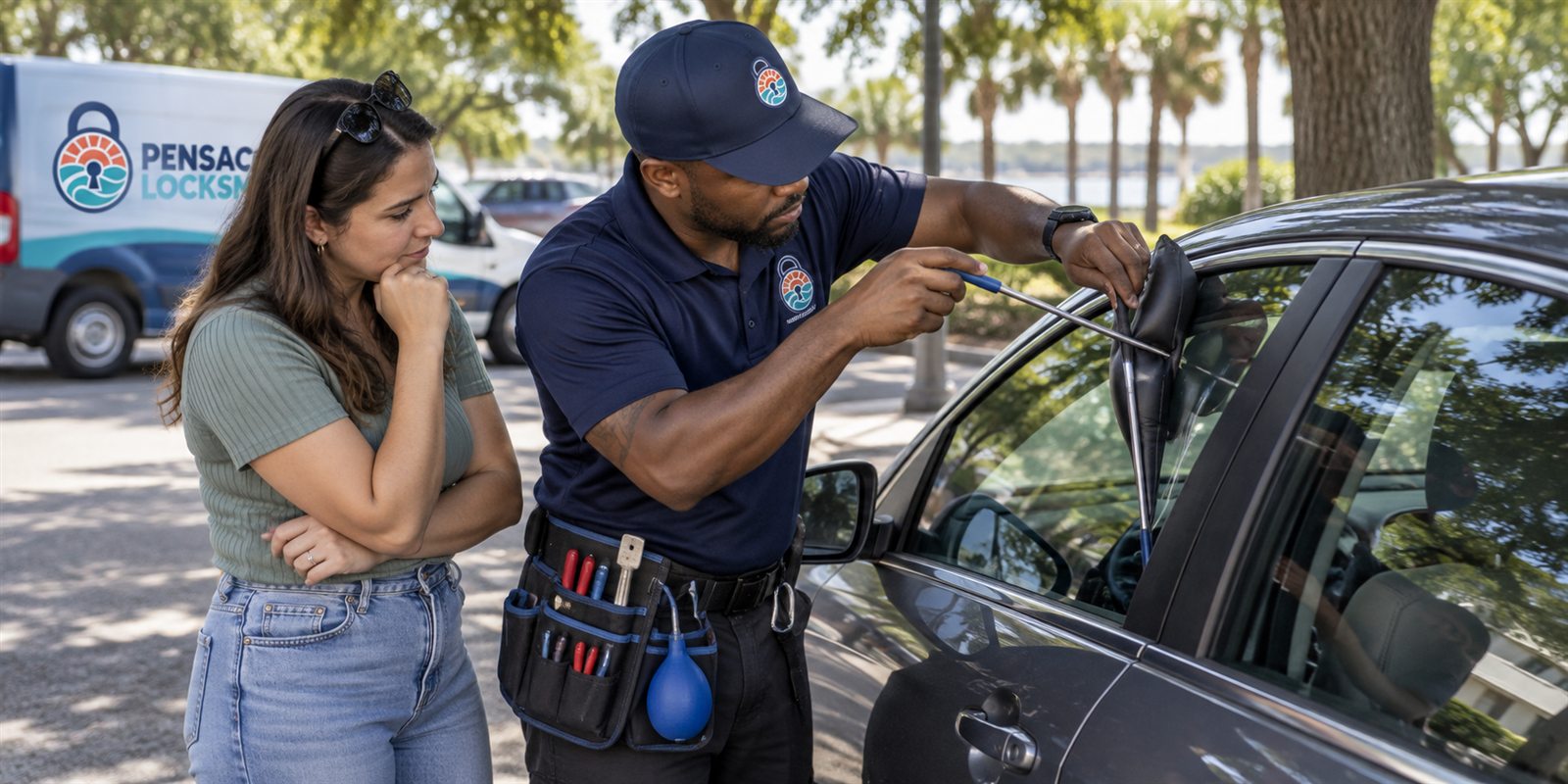
Before opening an Audi, cutting a key or programming one, a technician confirms that you are the owner or are authorized by the owner. We do this for every vehicle, whatever the brand, but it matters especially for vehicles that carry a high value and a strong security design. A key that is easy to get is a key that is easy to misuse.
What you will be asked to show is simple: identification and a document connecting you to the vehicle. The registration or title is typical. If the vehicle is leased or belongs to a company, tell us on the phone, and we will explain what other documents help, such as a letter of authority. Having these ready cuts the visit time.
Some owners find the check slightly inconvenient, particularly when stressed by a lockout. But the same process is what prevents a stranger from standing at your vehicle with a plausible story. It is a shared protection. If you cannot show any documents, explain the circumstance when you call, and we will tell you plainly whether we can proceed.
From arrival to a working key
The visit starts with the basics: the technician verifies who you are, reads the identification number from the plate and examines the key you have, if any. The next step is choosing the correct replacement fob or key blank. A blade, if needed, is cut and tested. The new fob is checked for basic function so that the technician is not working with a faulty part.
Then the technician connects the diagnostic equipment. The vehicle is identified and the tool states what operations are allowed for that model. Where the vehicle requires a security code or a handshake, the technician provides it according to the system. The new key is registered, and the vehicle stores its identity. Some steps involve waiting for the vehicle to complete internal checks.
The finish is the testing. The engine starts and runs. The remote buttons lock and unlock. The proximity link is checked at every door. If more than one key is being made, each goes through the full test. Finally, you hear how many keys the vehicle recognizes. If something does not pass, it is dealt with before the technician leaves, not after.
When we may not be the right first call
It would be unhelpful to hide this: a few Audi key situations are better handled through the maker's own channels. These often involve the newest security designs, vehicles with locked down modules or situations where a specific authorization is required that is not accessible to independent technicians. In such cases, even a skilled locksmith cannot do the programming.
We would rather tell you so at the start. If you call, describe the vehicle and the problem, and we will say whether we expect to complete it on site. If we are not sure, a technician can visit to assess, and the service call charge is explained before dispatch. You never need to guess about cost or outcome.
Even when we cannot program the key, we can often help with other parts of the problem: opening a locked vehicle, cutting an emergency blade, checking a fob's battery and signal, or removing a broken key from a lock. Not everything is a programming task. Telling us what you need lets us advise on what to do first. Call us and we will confirm availability.
All keys lost: what changes and what to prepare
With no key to start from, the technician works with the vehicle itself. The immobilizer must be coaxed into accepting a first key, and this usually requires more steps, more time and sometimes additional data. The vehicle must be present and accessible, with a healthy battery. A weak battery can disrupt the process or leave modules in an unclear state.
Preparation helps. Gather the registration, your identification and the vehicle identification number. Find any purchase paperwork that mentions how many keys came with the vehicle. If you remember the last place you saw the key, check there once more before calling. Sometimes a missing key turns up between the phone call and the arrival.
Think about security as well. If the missing key could be in someone else's hands, tell the technician you want it removed from memory. Only the keys you present at the end of the session will work afterward. This is a good moment to ask about a spare too, since the vehicle is already in learning mode and adding a second key costs little extra effort.

Fob batteries, flat vehicles and false alarms
Many calls about a key not working are not key failures. A weak fob battery shortens range, and the vehicle may display a message. A flat vehicle battery can prevent the doors from responding to the fob. A cold or damp start in the morning can make a marginal fob misbehave. Rule out these simple causes before assuming the key is broken.
To test the fob battery, try the emergency method in the owner's manual: use the hidden blade to open the door, and hold the fob against the marked spot to start the engine. If that works, the fob chip is alive and the battery is probably the problem. Replace it carefully, mindful of the orientation and the fragile clips.
If the vehicle is slow to crank or the dashboard flickers, the vehicle battery may be the culprit. A key job on a vehicle with a weak battery can go wrong, so a technician may recommend charging or replacing it first. We will tell you honestly if the actual problem is not the key. It does not help anyone to sell a key for a problem it will not fix.
Salt air, sun and the long life of a fob
Living on the Gulf Coast means humidity most of the year and salt in the air near the bay and the beaches. Fob electronics hate moisture. Over time, residue can build up on the contacts and a green or white crust may appear around the battery. If you notice this, replace the battery and clean gently with a dry swab. Persistent trouble suggests the board is affected.
Sunlight is another factor. A fob left on a dashboard bakes. Plastic cases fade and become brittle, and adhesive softens. Make it a habit to carry the fob with you. If you must leave it in the vehicle, as with a valet, choose a shaded spot. Heat also accelerates battery aging, so a fob kept cool tends to last longer.
Physical wear matters too. Big key rings with heavy accessories pull on the case and the blade hinge. Slim fobs suffer from bending in tight pockets. A soft pouch and a lighter ring cost nothing and reduce wear. If your fob shows cracks or loose buttons, address them before they lead to a failure at an inconvenient moment.
Used vehicles and unknown key histories
Buying a used Audi often means taking on a history you cannot see. The seller may hand over one key and keep a spare, or earlier owners may have had extra keys made. If you care about security, ask the technician to check how many keys the vehicle currently remembers, where the system allows it, and consider resetting to the keys you hold.
A related question is the condition of what you have been given. A fob with worn buttons, a cracked case or a failing battery may be ready for repair or replacement. A new battery and shell can restore a tired fob, provided the electronics are sound. A technician can test it and tell you whether it is worth keeping.
Paperwork matters, too. Because we confirm ownership before work, you need the title or registration in your name. If the transfer is still in progress, tell us so, and we will explain what is acceptable. Resolving this ahead of time means you will not be stuck on a day when the only key fails and the paperwork is incomplete.
Building a plan so you are never stranded
The simplest plan has three parts: two working keys, a record of the vehicle identification number and a known fallback. Keep one key in daily use and one at home, not in the vehicle. Photograph the identification number and registration and store the images where you can reach them from any device. Know where the emergency blade is and how to use it.
Add a yearly check. Press every button, try the emergency blade in the door lock, replace the battery if range has shrunk, and look at the case for cracks. This takes five minutes and catches problems while they are easy to fix. If something looks off, call and describe it. We can tell you whether it needs attention now or can wait.
Finally, decide in advance who you will call. A trusted locksmith who knows your situation is easier than a frantic search when you are locked out in the heat. Call us now to ask questions, learn how the process works for your vehicle and confirm availability. A calm conversation today saves a stressful afternoon later.
Convertibles, hatches and the other locks on the vehicle
A key does more than start the engine. Depending on the vehicle, it may also control the trunk release, the fuel door, a glove box lock and in some cases a roof mechanism or a power liftgate. When a replacement is made, these functions should all be tested. A fob that starts the engine but leaves the trunk release dead is only half finished.
Trunk and hatch cylinders on some vehicles are hidden behind trim or a badge, and owners forget they exist until the battery dies. If your vehicle has a mechanical backup on the trunk, ask the technician to test the emergency blade there as well as in the door. It is a small check that can matter on a day when electronics fail and your luggage is inside.
Water is the usual enemy of these hidden locks. Rain gets into the trunk seal area and salt air coats the cylinder. A dry graphite lubricant helps; oil attracts grit. If a lock feels stiff or gritty, tell the technician and have it looked at before it seizes. Easing a stiff lock early is simpler than extracting a stuck one later.
Common questions
Can an Audi key be programmed on site in Pensacola?
Often yes, though some systems are more restricted than others. The technician comes to the vehicle, confirms ownership, identifies the key family and programs with diagnostic equipment. If your vehicle needs resources we cannot reach, we will say so early. Call us with the details and we will confirm availability.
Why does my replacement fob not work even though it looks identical?
Looks do not settle compatibility. The frequency, chip family and internal electronics must match your vehicle, and a used fob may be locked to another vehicle. A technician can check a fob before you rely on it. Share the vehicle identification number and a photo of the fob when you call.
What happens if all my keys are lost?
The technician works directly with the vehicle to register a new key, which takes more steps than adding a spare. You can also ask for the lost keys to be removed from memory. If the job is complicated, a technician visits and the service call charge is explained before dispatch.
Can you open the vehicle if I am locked out?
Yes, in many cases, after we confirm ownership or authority. A technician uses entry methods intended to avoid scratches and sensor faults. Please avoid prying at the door yourself, since modern doors contain wiring and sensors that can be damaged. Call us and describe the situation.
How do I start the vehicle if the fob battery is dead?
Most vehicles let you hold the fob against a marked spot, such as near the start button or in a console pocket, so the vehicle can read a chip without battery power. Your owner's manual shows the location. Replace the battery promptly afterward, or ask a technician to do it.