
Content note: this page was written by Claude (AI) for Pensacola Locksmith.
Why small locks get overlooked until they fail
A mailbox lock turns twice a day and a file cabinet lock maybe once a month. Nobody thinks about them until the key breaks, the cylinder jams or the person who held the only key leaves. Then something important, like mail, tax records or tools, is stuck behind a small piece of metal.
Small locks are often inexpensive hardware made with soft metals and thin parts. They are built for convenience more than strength. That does not make them useless. For a mailbox, the lock protects against casual theft. For a file cabinet, it deters curious hands. Understanding the real purpose helps you decide how much attention a given lock deserves.
Because the hardware is small, many of these problems can be solved quickly. A cylinder can be replaced, a lock can be rekeyed, a key can be cut from the lock itself, or a stuck lock can be opened without damage. The right approach depends on the lock type, its condition and whether you need to preserve it.
Mailbox locks: apartment, cluster and private boxes
Mailboxes come in several kinds. Residential curbside boxes seldom have locks, though locking versions exist. Apartment and cluster mailboxes, which stand in groups, are usually controlled by the postal service for the main compartment, and by building management for any extra parcel lockers or separate private boxes. Rules for who may open or change them vary.
For postal-controlled boxes, only the postal authority may service the lock on the official mail compartment, and a locksmith should not tamper with them. Private locking mailboxes, wall-mounted boxes with a key lock, and decorative boxes owned by a resident or business are different. Those we can open, rekey or replace once ownership is confirmed.
If your key is lost on a private locking mailbox, the usual solutions are to pick it open, remove the cylinder, or drill and replace it. The goal is to avoid damaging the box. We discuss the lock type with you over the phone and tell you which approach is likely, and whether you should contact the property manager first.
File cabinets and desk drawers
Office furniture locks are usually wafer or disc tumbler designs. Wafer locks are simple, using flat plates rather than pins. They are quick to open for a trained technician and inexpensive to rekey or replace. Many file cabinets are keyed alike, which is convenient but also means one key may open dozens of cabinets.
When the key is lost, a technician can often open the cabinet without damage and cut a new key. If the cabinet is old, parts may be worn, and the lock may need replacing. Cabinet makers use common cylinder sizes, so a replacement lock that matches the cutout usually exists, which can often be keyed to a key you prefer.
For sensitive records, remember that a basic cabinet lock is a deterrent, not a vault. Anyone with a determined effort can bypass it. If the contents are very valuable or confidential, a stronger container or a safe is a better choice. A locksmith can talk through realistic options for the type of documents you keep.
Tool chests, storage boxes and trailer compartments
Tool chests, job site boxes and storage cabinets hold valuable equipment. Their locks vary from small cam locks to heavier padlock hasps. Cam locks are simple and common on cabinets and cases. They use a short rotating arm that sits behind a lip, and a tiny key turns it.
Cam locks can be replaced easily, since the housing is usually held by a single nut. Replacement locks come in many lengths and cam shapes, and matching the old one is key. Keyed-alike sets allow several boxes to share a single key, which tradespeople often prefer.
For items of real value, the problem is rarely the lock alone. Thin sheet metal around the lock, weak hinges and exposed hasps can be forced. A stronger lock on a flimsy box adds little. We are honest about that, and we can suggest reinforcement, a better hasp or a different type of lock if your situation warrants it.
What can be rekeyed, replaced or opened
Rekeying is possible on many pin tumbler small locks, and it means changing the internal pins so a new key works and the old one does not. It is useful when keys have gone missing or a former user should no longer have access. Some very inexpensive locks cannot be rekeyed economically and are better replaced.
Replacement means fitting a new lock into the same hole. This works when the cutout size and mounting match. A new lock with a fresh key is often the best choice for old, worn or damaged hardware. Choosing a better quality replacement may extend the life of the cabinet or box.
Opening a locked item without damage is possible for many small locks. A skilled technician uses fine tools to manipulate the mechanism. Some locks resist, and drilling is occasionally necessary. If drilling is required, we explain it first, so you know the lock will be replaced. Opening is done only after ownership or authority is confirmed.
Ownership and authority for small items
Even small locks require sensible checks. If you ask us to open a cabinet, we need to be comfortable that it is yours or that you have authority to open it. That can be as simple as describing how you came to own it and showing where it is. Items inside a business belong to the business, so an employee may need the owner's permission.
Tenants should be careful with items that belong to a landlord, such as built-in mailboxes, storage lockers and utility cabinets. These are often controlled by the property manager. We may ask you to contact them first, or for a message confirming that you can proceed. It protects you as well as us.
Estate situations, such as an inherited desk or cabinet, are also handled thoughtfully. We ask about your relationship and what authority you hold. Sometimes a document is helpful. The aim is never to be difficult, but to ensure that locks are opened by people who are entitled to open them, whatever the size of the lock.
Broken keys and stuck cylinders
A key that snaps inside a small lock is a frequent call. Small keys are thin, and repeated use of a worn key wears the cuts and weakens the blade. The broken piece may be sitting visibly in the keyway or hidden deeper. Do not try to dig it out with a pin or a knife, since that tends to push it further in.
A technician uses a thin extractor to grip the broken piece and withdraw it. Once removed, the lock can be tested. If the pins are damaged, the lock may be replaced or rekeyed. A new key cut from the lock is a common outcome. Keeping the broken piece helps us identify the key type.
A cylinder that will not turn is another typical complaint. Dirt, rust, bent wafers and misaligned parts are common causes. Heavy household oil makes things worse by gathering dust. A dry lubricant applied lightly sometimes helps. When a lock resists, forcing it risks breaking the key. A quick call is usually better than a struggle.
Humidity, salt air and outdoor small locks
Mailbox locks and outdoor cabinet locks in our area face tough conditions. Humidity, salt in the air and driving rain corrode cheap metals fast. A lock that was smooth when installed can seize within a season or two. Brass and stainless steel options last longer than zinc and plated steel.
If your lock is outdoors, a protective cover or a flap over the keyhole reduces exposure. A bit of dry lubricant each season keeps parts moving. Avoid wet or thick oils that attract grit. For gates, sheds and utility boxes by the water, choose rated weatherproof padlocks and hardware where practical.
After storms, check outdoor locks and hasps. Wind-driven rain and debris can push grit into keyways. A lock that suddenly feels rough can sometimes be cleaned out and restored, and catching it early avoids a stuck lock at an awkward time. If you manage several properties, a seasonal check of outdoor small locks is a worthwhile habit.
Choosing replacements and keeping spares
When replacing a small lock, think about how it is used. A mailbox lock that is touched daily deserves a smooth, durable cylinder. A file cabinet lock that is rarely used can be simpler. For a tool chest on a worksite, a lock that resists prying matters more than fancy features. We can recommend options that fit your use.
Keyed-alike options are handy. You can have a mailbox, a file cabinet and a shed all open with the same key, which cuts down on the number of keys you carry. The tradeoff is that losing one key affects all of them. For households and small offices, that exchange is usually acceptable.
Always make spares. A single key for any lock is a recipe for repeat problems. Keep a spare in a safe place, separate from the original. Label spare keys discreetly rather than writing the address on them. Have a note of which key goes with which lock, particularly if you manage many small locks across properties.
What to have ready when you call
Describe the item: mailbox, cabinet, drawer or box. Mention the brand if visible, the size and where the lock is located. Tell us whether the key is lost, broken or simply stiff. A clear photo of the lock face and any numbers stamped on it can be very helpful. Some small locks carry a code that identifies the key.
Be ready to explain who owns the item and how you came to have it. For a business, mention your role. For a rental, mention whether the property manager is aware. If the item is somewhere hard to reach, say so. Quotes are given by phone for straightforward jobs, and we explain what to expect before we arrive.
If a job turns out to be more complicated, a technician visits and the service call charge is explained before dispatch. Please call to confirm availability for your location in Pensacola or the surrounding area. Small locks are small jobs in most cases, and we aim to handle them with the same care and honesty as any larger project.
Padlocks, hasps and the locks that hold gates and sheds
Many small lock calls turn out to involve padlocks. A padlock is only as good as the hasp it connects to, and the hasp is only as good as the screws holding it. A heavy padlock on a thin hasp fixed with short screws into soft wood will give way before the lock does. Checking the whole assembly is part of a proper small lock visit.
Padlocks also vary a great deal in construction. Laminated steel bodies, hardened shackles and shrouded designs resist cutting and prying better than thin cast bodies with exposed shackles. Keyed-alike sets let several padlocks open with a single key, which is handy for a property with a gate, a shed and a storage cage.
When a padlock key is lost or a combination forgotten, the choices are to open it, cut it, or rekey where possible. Cutting a padlock destroys it, so opening is preferred when the lock is worth keeping. For outdoor use near the water, look for models with corrosion protection, and treat the keyway with a dry lubricant from time to time.
Safes and lockboxes: where small locks end and other jobs begin
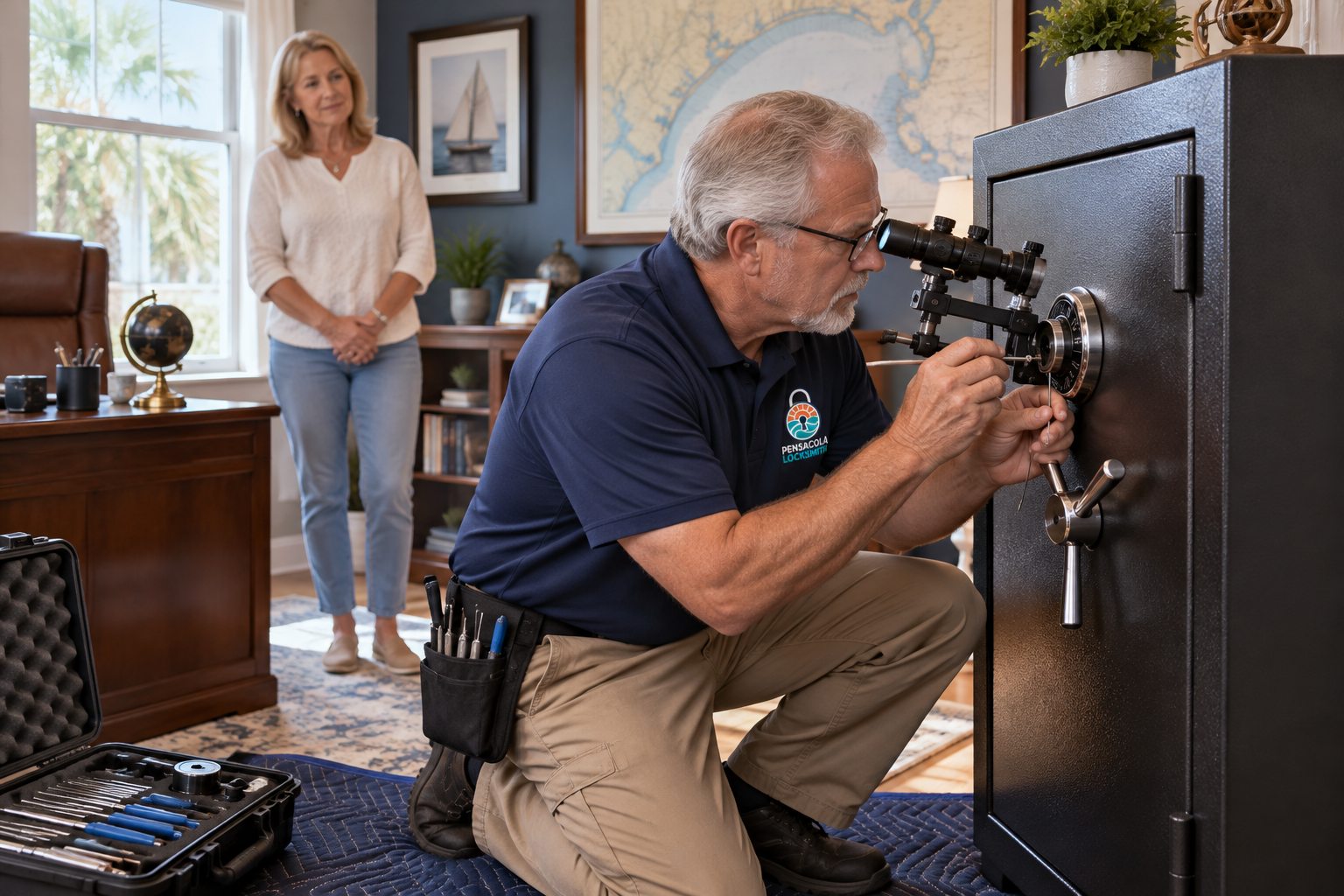
Sometimes a call about a small lock turns into a different kind of job. A cash box, a small safe or a wall lockbox may look like a cabinet but behave very differently. Safe locks involve combination or electronic mechanisms, relockers and hardened plate, and they are not opened by the same methods as a desk drawer.
If you have a small fire box or document safe with a lost key or forgotten code, tell us the brand and whether the lock is keyed or digital. Some can be opened by manipulation or by using the manufacturer's information when ownership is proven. Others need more involved work. We explain the likely approach and what a technician visit would involve.
Realistic expectations help. A small lockbox is a convenience and a deterrent against casual access, not protection against a serious theft attempt. If you are storing something truly valuable or irreplaceable, ask about a rated safe, a bank box or professional storage. Honest advice about the limits of a small lock is part of the service.
Seasonal and situational small lock needs
Small lock demand shifts with the calendar. Before hurricane season, people gather important papers into a document box or cabinet and discover the key is missing. After a move or a change of tenants, mailboxes and storage lockers need new keys. At the start of a school term, students living near the university or college often need help with a small locker or desk drawer.
Vacation rental owners have their own routine. Owner closets, linen cabinets and utility cupboards inside a rental are often locked so guests cannot reach personal items, and those locks need rekeying when staff change. Having a consistent, labeled set of small keys for each property avoids confusion between turnovers.
Military families moving in and out of the area sometimes deal with storage cabinets, trunks and lockers that have been in transit for months. Keys get separated from locks, and tiny locks are hard to match. Bringing the item along with any key you have, and describing its history, helps us find an efficient way to open or restore it.
Common questions
Can you open a locked mailbox?
We can open privately owned locking mailboxes once ownership is confirmed. Postal-controlled compartments are handled by the postal authority, not by a locksmith. For apartment or cluster boxes, you may need to contact management first. Call us with a description and we will tell you what applies.
My file cabinet key is lost. Do I need a new cabinet?
Usually not. Many cabinet locks can be opened without damage and a new key cut, or the cylinder can be replaced and keyed as you like. Older locks may be worn and better replaced. We confirm ownership before opening and explain the approach beforehand.
Can all small locks be rekeyed?
Many pin tumbler small locks can be. Some very inexpensive wafer and cam locks are not worth rekeying and are easier to replace. The technician examines the lock and recommends whichever option is sensible for the lock and your needs.
What should I do if a key breaks in the lock?
Stop and do not dig at it. Keep the broken piece if you have it, and call us. A thin extractor can usually remove the broken part without harming the lock. Afterward, a new key can often be cut from the lock itself.
How do quotes work for small lock jobs?
Quotes are given by phone based on what you describe. If the job turns out to be more complicated, a technician visits and the service call charge is explained before dispatch. Please call to confirm availability, and have proof of ownership or authority ready.